

From Verrocchio's workshop to the great families' commissions
Room A35 is almost entirely devoted to Leonardo da Vinci, from his beginnings as an apprentice to a commission he would abandon without ever finishing it. Room A38, a little further on, brings together Raphael and Michelangelo around a single commission from one Florentine family — solid proof that these two artists, rarely associated with one another, did in fact work for the same clients, at the same time.
1. Room A35 — the angel said to have made his master give up
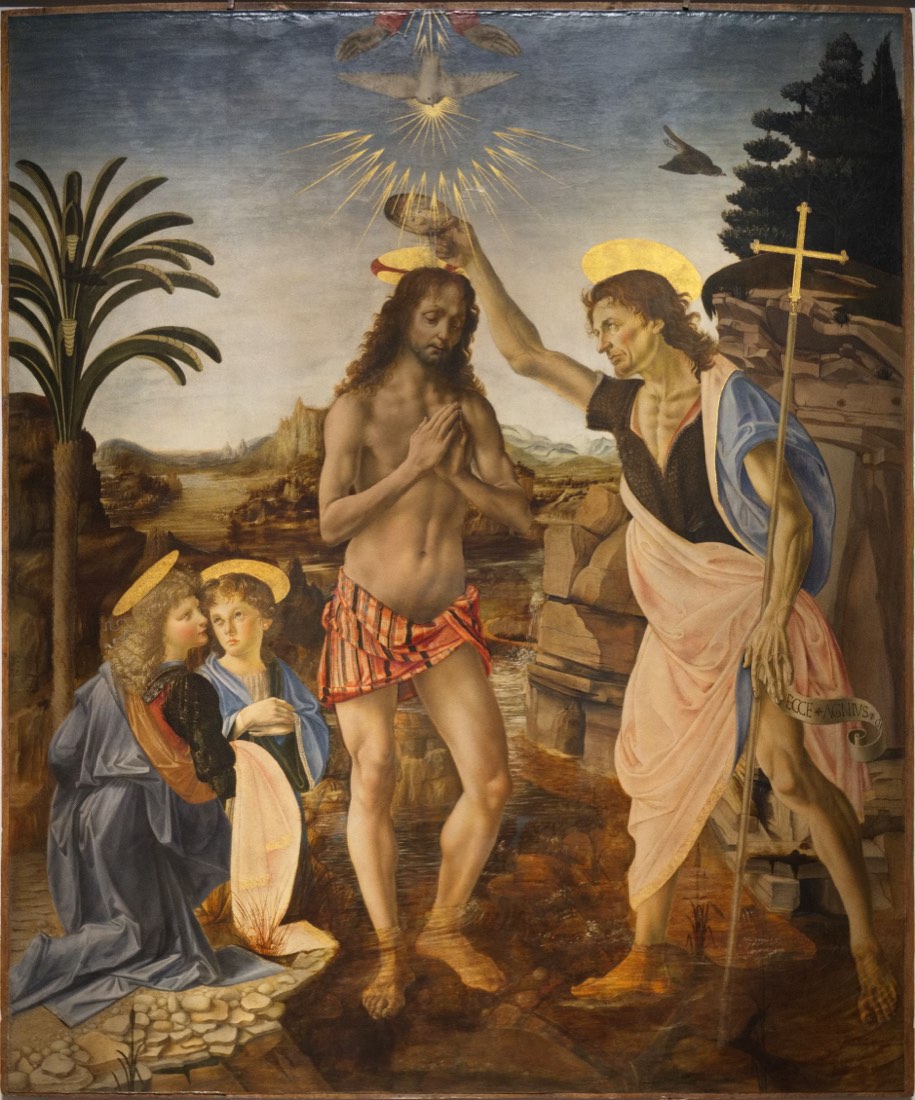
The Baptism of Christ, painted around 1475 in Andrea del Verrocchio's workshop, carries the workshop's collective signature — but the angel in profile, on the left, is unanimously attributed to the young Leonardo, then an apprentice. Half a century later, Vasari would claim that Verrocchio, seeing this angel surpass his own painting, gave up painting altogether to devote himself solely to sculpture. It makes for a good story; art historians today consider it exaggerated — records show Verrocchio had already largely moved away from painting before this panel, for career reasons rather than wounded pride. What remains verifiable, however, is the difference in handling visible to the naked eye: the softness of the modelling and the depth of the landscape behind Leonardo's angel stand apart from the rest of the panel.
2. Room A35 — the Annunciation, Leonardo's first major painting
The Annunciation, painted around 1472-1476 while Leonardo was still an apprentice under Verrocchio, is his first major independent painting — long attributed to Ghirlandaio after it entered the Uffizi in 1867, before the historian Karl Eduard von Liphart restored the attribution to Leonardo in 1869, since confirmed by preparatory drawings held at Christ Church, Oxford. The angel Gabriel holds a lily, a symbol of both Mary's virginity and the city of Florence, set in a walled garden painted with a single vanishing point already under full control.
Look for the Virgin's right arm: it appears oddly elongated, a detail that has puzzled historians for a long time — the painting originally hung above a side altar, seen from below and to the left, which would have optically corrected this apparent distortion. Some scholars also believe the angel's wings, considered disproportionate, were enlarged by a later hand — Leonardo himself had likely studied them from actual bird anatomy.
3. Room A35 — a commission interrupted by the Duke of Milan
The Adoration of the Magi, commissioned in 1481 by the Augustinian monks of San Donato a Scopeto for their church's high altar, was left unfinished: Leonardo departed for Milan to serve Duke Ludovico Sforza before completing the colour, leaving the brown underdrawing visible against a pale ground. It lays bare his method of building through value before colour — an approach entirely different from his contemporaries, who laid down colour first. Look closely at the rearing horses and ruins in the background: these are near-independent studies, finished to a degree that rivals a completed painting, while the faces of the Magi in the foreground remain no more than a sketch.
4. Room A38 — a Florentine wedding, two commissions, two geniuses
In 1504, the wealthy cloth merchant Agnolo Doni married Maddalena Strozzi, from one of Florence's great families. To mark the union, Doni commissioned a Holy Family from Michelangelo — then known chiefly as a sculptor — painted on a round panel, the Doni Tondo: it is the only fully finished panel painting to survive by his hand. The twisting of the bodies, borrowed directly from the vocabulary of sculpture, already anticipates the figures he would soon paint on the ceiling of the Sistine Chapel.
The same Agnolo Doni commissioned, at the same time, a portrait of himself and one of his wife from Raphael — then a young painter on the rise, recently arrived from Umbria. The two commissions, hung today in the same room, allow a direct comparison rarely possible elsewhere: one client, one year, two radically different ways of understanding the human figure — Michelangelo's sculptural twist against Raphael's minute observation of face and jewellery.
5. Room A38 — the Madonna of the Goldfinch, broken into seventeen pieces
The Madonna of the Goldfinch, painted by Raphael in 1506 to mark the wedding of the wool merchant Lorenzo Nasi to the Florentine noblewoman Sandra Canigiani, shows the Virgin seated on a rock, a book in hand, looking at the two children before her — Christ and the young Saint John the Baptist, who holds a goldfinch, a symbol of the Passion to come. The pyramidal composition owes much to the lessons of Leonardo, whom Raphael was studying closely at this point in his Florentine career.
In 1547, the Nasi house collapsed in a landslide and the painting shattered into seventeen fragments. Pieced back together and restored — probably by Michele di Ridolfo del Ghirlandaio — it still bears the marks of that accident if you look closely at the fracture lines. Painted the same year as the two Doni portraits hanging in this room, it shows a Raphael exploring two different genres at once, for the same generation of Florentine patrons.
6. Rooms A38 and A40 — Fra Bartolomeo, Raphael’s friend
In room A38, the wings of Piero del Pugliese’s small tabernacle, painted around 1497 by Fra Bartolomeo (oil on wood, 20.3 × 8.9 cm and 18.3 × 9.4 cm), are painted on both sides. Closed, they show a monochrome Annunciation in a simple room dominated by a high portal of pale stone; open, they reveal the Adoration of the Child on the left, in a quiet landscape of rocks and small trees lining a river, and the Presentation in the Temple on the right. They accompanied a marble relief by Donatello, the Dudley Madonna (now in the Victoria and Albert Museum, London), in a small tabernacle commissioned by the wealthy Florentine merchant and collector.
In room A40, devoted to Fra Bartolomeo and his school, Porzia (about 1495, oil on wood, 108 × 50 cm) shows the Roman noblewoman standing in a niche of grey stone bordered by pilasters with plant ornament, a pearl hair clip holding a transparent veil across her shoulders. She gestures towards burning embers, alluding to her act after the death of her husband Brutus. The painting predates the artist’s monastic vows and shows the influence of Flemish painters active in Florence.
How much time
Allow a good hour for the three rooms, pausing on the contrast in handling between Leonardo's angel and the rest of the Baptism, then between the Doni Tondo and the portraits around it.
- The Baptism of Christ (Verrocchio and Leonardo, Room A35) — 7 minutes.
- The Annunciation (Leonardo, Room A35) — 8 minutes.
- The Adoration of the Magi (Leonardo, Room A35) — 8 minutes.
- The Doni Tondo (Michelangelo, Room A38) — 8 minutes.
- Portrait of Agnolo Doni (Raphael, Room A38) — 7 minutes.
- Portrait of Maddalena Doni (Raphael, Room A38) — 7 minutes.
- The Madonna of the Goldfinch (Raphael, Room A38) — 8 minutes.
- Wings of Piero del Pugliese’s tabernacle (Fra Bartolomeo, Room A38) — 6 minutes.
- Porzia (Fra Bartolomeo, Room A40) — 5 minutes.
Sources and verification
Checked against the official notices of the Uffizi Gallery (uffizi.it) and cross-checked with Wikipedia EN/FR.
- Uffizi — The Baptism of Christ, Verrocchio and Leonardo
- Wikipedia EN — The Baptism of Christ (Verrocchio and Leonardo)
- Uffizi — Adoration of the Magi, Leonardo da Vinci
- Uffizi — Holy Family, known as the Doni Tondo, Michelangelo
- Uffizi — Portraits of Agnolo and Maddalena Doni, Raphael
- Magenta Florence — A New Room for Michelangelo & Raphael in the Uffizi
- Uffizi — Annunciation, Leonardo da Vinci
- Wikipedia EN — Annunciation (Leonardo)
- Uffizi — Mary, Christ and the young John the Baptist, known as the "Madonna of the Goldfinch", Raphael
- Wikipedia EN — Madonna del Cardellino
- Uffizi Galleries — Adoration of the Child, Fra Bartolomeo
- Uffizi Galleries — Porzia, Fra Bartolomeo
Displays and room openings can change. Check the Uffizi Gallery website on the day of your visit before following a route.
Continue your visit
The Uffizi Gallery, Florence
Listen to the commentary in the gallery
This route gives you a thread to follow. In front of an artwork, CulturAll adds the audio commentary: photograph the work or its label, listen, then ask your questions.

