

A century and a half in two rooms
Room A4 brings together three Virgin and Child paintings, each painted by a different master roughly a generation apart. Room A8, a little further on, shows what remains of this religious tradition a hundred and fifty years later, at the exact moment it meets a technical discovery that will change everything: mathematical perspective.
This is not a chance arrangement. The Uffizi organised these rooms so visitors can literally watch painting change method, almost with the naked eye, from one panel to the next.
1. Room A4 — Three Madonnas, three generations
Cimabue's Santa Trinita Maestà, painted around 1290-1300 for the Florentine church of Santa Trinita, remains an icon in the strict sense: a flat gold ground, a throne with no real depth, figures lined up according to a hierarchy of sizes inherited from Byzantine painting. Next to it, Duccio's Rucellai Madonna — a Sienese painter whose commission is precisely dated to 15 April 1285, for the Laudesi confraternity of Santa Maria Novella — keeps the gold ground but softens the drapery and the faces.
The break comes with the third panel. Giotto's Ognissanti Madonna, painted around 1310 for the Florentine church of Ognissanti, gives the Virgin a body that seems to press down on her throne: knees are visible under the drapery, the throne itself is built with a hint of depth, the angels overlap instead of lining up. Twenty to thirty years separate this painting from the previous one — look at the three side by side, and that is how long it took Florentine painting to stop being an icon and start representing a body in space.
2. Room A4 — a second Giotto, lost then found
The Badia Polyptych, painted by Giotto around 1300 for the high altar of the church of the Badia Fiorentina, brings together five triangular-topped panels: at the centre, the Virgin and Child; on either side, four saints shown as busts — Nicholas of Bari, John the Evangelist, Peter and Benedict — each identified by a name inscribed beneath the panel and by their traditional attributes, a crosier for Nicholas, a stole for Peter.
The work drops out of the historical record after being replaced on the Badia's altar in 1568 by a painting by Vasari, then moved to the vestibule of the convent's refectory. It resurfaces in the nineteenth century in the archives of the Santa Croce museum, identified thanks to a cartouche reading "Badia di Firenze," added in 1810 — it was the art historian Ugo Procacci who established, during the Second World War, that it had been mistakenly transferred to Santa Croce during the Napoleonic period. Restored once in 1958, and again after the Arno flood of 1966, it joined the Uffizi that same year.
3. Room A8 — two hands on one panel, and a gold ground that lingers
The Virgin and Child with Saint Anne, painted around 1424-1425 for the church of Sant'Ambrogio at the request of a wool merchant, Nofri di Buto Buonamici, is signed by two hands: Masaccio and his elder Masolino da Panicale. The difference is visible if you look for it: the Virgin and Child in the foreground have a volume and weight found in no Florentine painting fifteen years earlier — that is Masaccio's hand, who would die at just twenty-six, barely three years later. Saint Anne, set back behind them, is still treated with Masolino's softer, more linear manner.
A few steps away, Fra Angelico's Coronation of the Virgin (around 1432, painted for the church of Sant'Egidio) shows that an entire gold ground could still be justified a century after Cimabue — but for a different reason: here it is no longer a convention, but a deliberate choice to represent paradise, a place that has precisely no need of earthly space. The contrast with the nearby Saint Anne panel, painted in the same decade, shows that Masaccio's emerging realism did not immediately replace the older manner: the two coexisted, according to what the subject demanded.
In the same room, Fra Angelico’s Madonna and Child Enthroned with Angels (1435, tempera on wood with gold ground, 134 × 59.5 cm) comes from a polyptych painted for the church of San Michele Arcangelo in Pontassieve, commissioned by the da Filicaia family; it reached the Uffizi in 1924 for restoration and has been part of the collection since 1949. It keeps Gothic elements — a pointed arch, a gold ground — but the marble step beneath the throne and the chiaroscuro modelling of the Virgin are already Renaissance.
The Coronation of the Virgin regained its predella in 2024: the two small panels of the Marriage and the Death of the Virgin, separated from the altarpiece in the sixteenth century, remained in the San Marco Museum until they were reunited with the main panel in spring 2024. The main panel had entered the Uffizi in 1825.
4. Room A8 — Paolo Uccello and battle as a problem of geometry
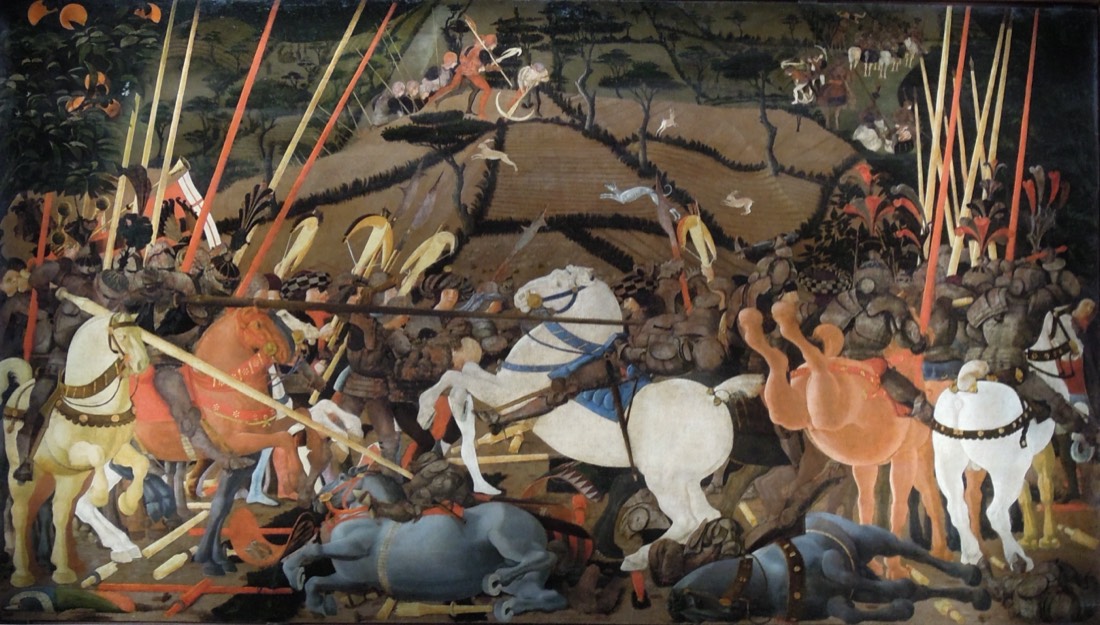
Paolo Uccello's Battle of San Romano, painted around 1438, is the central panel of a set of three large canvases commissioned to celebrate the Florentine victory over Siena in 1432. The other two panels are not in Florence: one is at the National Gallery in London, the other at the Louvre — the battle itself, split across three countries, can now only be seen whole in books.
What Paolo Uccello paints here is not really a battle: it is a demonstration of perspective applied to a melee of horsemen. Look for the broken lances on the ground: they are arranged in lines that all converge toward a single vanishing point, a geometric exercise almost more visible than the combat itself. The horses, rearing or fallen, are painted in foreshortening — a technical feat Uccello was so obsessed with that Vasari, writing a century later, claimed his wife complained of finding him awake all night calculating vanishing points instead of coming to bed. The anecdote may be embellished, but the painting itself proves the obsession.
How much time
The two rooms follow directly on from each other in the wing devoted to early painting, on the second floor. Allow a good hour if you take the time to compare the three Madonnas before moving to the next room.
- Santa Trinita Maestà (Cimabue, Room A4) — 6 minutes.
- Rucellai Madonna (Duccio, Room A4) — 6 minutes.
- Ognissanti Madonna (Giotto, Room A4) — 6 minutes.
- Badia Polyptych (Giotto, Room A4) — 7 minutes.
- Virgin and Child with Saint Anne (Masaccio and Masolino, Room A8) — 9 minutes.
- Coronation of the Virgin (Fra Angelico, Room A8) — 8 minutes.
- Battle of San Romano (Uccello, Room A8) — 10 minutes.
- Madonna and Child Enthroned with Angels (Fra Angelico, Room A8) — 6 minutes.
- Predella of the Coronation: Marriage and Death of the Virgin (Fra Angelico, Room A8) — 4 minutes.
Sources and verification
Checked against the official notices of the Uffizi Gallery (uffizi.it) and cross-checked with Wikipedia EN/FR.
- Uffizi — Virgin and Child Enthroned, and Prophets (Santa Trinita Maestà), Cimabue
- Uffizi — Virgin and Child Enthroned, surrounded by Angels (Rucellai Madonna), Duccio
- Wikipedia EN — Ognissanti Madonna (Giotto)
- Wikipedia EN — Badia Polyptych (Giotto)
- Wikipedia EN — Virgin and Child with Saint Anne (Masaccio)
- Wikipedia EN — Coronation of the Virgin (Fra Angelico, Uffizi)
- Uffizi — Battle of San Romano, Paolo Uccello
- Wikipedia EN — The Battle of San Romano
- Uffizi — Madonna and Child Enthroned with Angels (Pontassieve), Beato Angelico
- Uffizi — Glorification of Mary (with predella), Beato Angelico
Displays and room openings can change. Check the Uffizi Gallery website on the day of your visit before following a route.
Continue your visit
The Uffizi Gallery, Florence
Listen to the commentary in the gallery
This route gives you a thread to follow. In front of an artwork, CulturAll adds the audio commentary: photograph the work or its label, listen, then ask your questions.

