

One workshop, two temperaments
Around 1461-1462, a teenager named Alessandro di Mariano Filipepi — who would become Botticelli — begins his apprenticeship under Fra Filippo Lippi, one of the most sought-after Florentine painters of his day and a favourite of the Medici. It is there that he learns to build melancholic figures with a very clean outline and few shadow contrasts — a manner still recognisable, fifteen years later, in his Primavera and Birth of Venus.
At the same time, in a neighbouring workshop, a pair of brothers with opposite temperaments is at work: Antonio del Pollaiolo, obsessed with movement and muscular anatomy, and his brother Piero, drawn more to the texture of fabric and precise portraiture. Neither trained Botticelli — but in 1470, a single commission would put them, unwittingly, on the same wall as him, years before his name meant anything.
1. Room A9 — The Coronation of the Virgin, Lippi's great altarpiece
The Coronation of the Virgin, painted by Filippo Lippi between 1441 and 1447, is an immense 220 x 287 centimetre panel commissioned by Francesco Maringhi, procurator of the church of Sant'Ambrogio in Florence. The composition, unusually dense for its time, gathers a crowd of saints and angels in informal postures around Christ enthroned in exaggerated perspective, crowning a kneeling Virgin before him.
Lippi painted himself into the crowd, in a Carmelite friar's habit, near Saint Ambrose — a discreet self-portrait by a painter who had left the order under circumstances never fully explained. The panel adorned the church it was painted for until it was stolen in 1810; it then passed through the Galleria dell'Accademia before reaching the Uffizi. This way of painting numerous, individualised figures, almost portrait by portrait, is another part of the inheritance Botticelli carried out of this workshop, alongside the pure line more often associated with his name.
2. Room C6 — Madonna and Child with Two Angels, the direct model
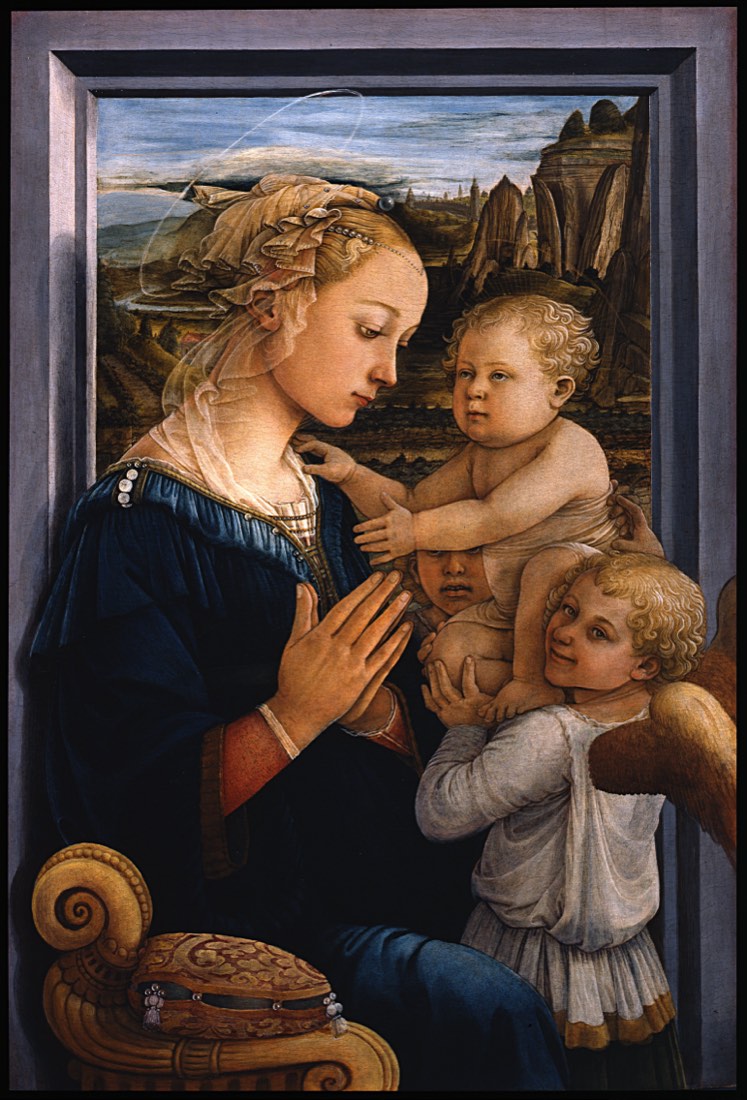
Filippo Lippi's Madonna and Child with Two Angels, painted around 1465, is one of the most copied compositions of the Florentine Renaissance: the Virgin in profile, in prayer before the Child held up by two angels smiling straight at the viewer. The landscape in the background, with its river and jagged rocks, is one of the first in Florentine painting to give a real sense of distance.
Lippi paints faces with an almost secular gentleness for his time — a model Botticelli would take up directly in his own Madonnas, pushing the outline even further at the expense of volume. This is the painting most art historians reach for first to show, point by point, what Botticelli owed his master.
3. Rooms A10 and A11 — the Pollaiolo brothers, and the very first Botticelli
Saints Vincent, James the Great, and Eustace, painted jointly by Antonio and Piero del Pollaiolo between 1466 and 1468, is the oldest witness to their collaboration in this room: a large 242 x 235 centimetre altarpiece, frame included, where the three figures stand out against a vast landscape. The division of labour between the brothers is already visible here, Antonio more at ease with space and the naturalism of landscape, Piero with the precision of fabric and faces.
In 1469, the Tribunale della Mercanzia — the court that ruled on disputes between Florentine guilds — commissioned Piero del Pollaiolo to paint a cycle of the seven Virtues, meant to decorate the backs of the benches in its audience hall on Piazza della Signoria. Piero painted Charity, Faith, Temperance, Prudence, Hope and Justice, all around 1469-1472 on panels of the same format, roughly 168 x 90 centimetres. These six canvases, with their poised, hieratic figures, carry the mark of a former goldsmith: the meticulous rendering of basins, fabrics and jewellery often outweighs any sense of movement.
The seventh Virtue, Fortitude, escaped Piero: the commissioner Tommaso Soderini insisted it go instead to a young painter with no great name yet, Sandro Botticelli, over the protests of Piero and Antonio. Botticelli delivered his panel in 1470 — the very first documented painting of his career. Already visible in this armoured figure holding a ruler's sceptre is the melancholic, slightly absent expression that the Uffizi itself recognises as the lasting signature of his female figures, five years before the Primavera. Piero's Portrait of a Lady, painted around 1475-1480, shows an entirely different kind of precision: strict profile, an elaborate hairstyle set with jewels, a dark red velvet dress edged in gold trim — attention paid to fabric and goldsmithing rather than to the movement of the body. In rooms A10 and A11, in short, lies the whole subject of this route: two brothers, a still-unknown young Botticelli, and several different answers to the same question of likeness.
4. A pocket-sized diptych, just before the great rooms
In the passage linking these rooms to those of the Primavera and the Birth of Venus hang two very small panels by Botticelli, The Return of Judith to Bethulia and The Discovery of the Body of Holofernes — 31 x 24 centimetres each, painted around 1470-1472, only a few years after Fortitude. Judith, richly dressed, a sword in one hand and an olive branch in the other, crosses a mountainous landscape toward the walled city of Bethulia while her servant Abra carries, hidden in a sack, Holofernes's severed head; the second panel shows the Assyrian soldiers discovering the body.
The two panels originally formed a diptych mounted in a single walnut frame; they belonged to the Florentine collector Ridolfo Sirigatti before entering the Medici collections. At this reduced scale, almost that of a miniature, Botticelli is already exploring the fluid line and suspended movement that would define his great mythological compositions a few years later.
How much time
These rooms lead directly into those where the great Botticellis — Primavera and the Birth of Venus, rehung facing each other in late 2025 as part of the new permanent installation of the Botticelli rooms — are now displayed. Allow close to an hour to go through all nine works; half that if you stop only at the two Lippis and Botticelli's Fortitude.
- Background on Lippi's workshop and the Pollaiolo brothers — 5 minutes.
- Room A9 — The Coronation of the Virgin (Lippi) — 7 minutes.
- Room C6 — Madonna and Child with Two Angels (Lippi) — 7 minutes.
- Room A10 — Saints Vincent, James the Great, and Eustace (Antonio and Piero del Pollaiolo) — 6 minutes.
- Room A10 — Charity (Piero del Pollaiolo) — 3 minutes.
- Room A11 — Temperance (Piero del Pollaiolo) — 3 minutes.
- Room A10 — Faith (Piero del Pollaiolo) — 3 minutes.
- Room A10 — Prudence (Piero del Pollaiolo) — 3 minutes.
- Room A10 — Hope (Piero del Pollaiolo) — 3 minutes.
- Room A10 — Portrait of a Lady (Piero del Pollaiolo) — 5 minutes.
- Room A10 — Fortitude (Botticelli, 1470) — 7 minutes.
- The Return of Judith to Bethulia (Botticelli) — 5 minutes.
- The Discovery of the Body of Holofernes (Botticelli) — 5 minutes.
Sources and verification
Checked against the official notices of the Uffizi Gallery (uffizi.it) and cross-checked with Wikipedia EN/FR.
- Uffizi — Madonna and Child with Two Angels, Filippo Lippi (Room C6)
- Uffizi — Coronation of the Virgin, Filippo Lippi (Room A9)
- Wikipedia EN — Coronation of the Virgin (Filippo Lippi)
- Uffizi — Saints Vincent, James the Great, and Eustace, Pollaiolo brothers (Room A10)
- Uffizi — Charity, Piero del Pollaiolo (Room A10)
- Uffizi — The Temperance, Piero del Pollaiolo (Room A11)
- Uffizi — Fortitude, Sandro Botticelli (Room A10)
- Wikipedia EN — Fortitude (Botticelli)
- Uffizi — Portrait of a Lady, attributed to Piero del Pollaiolo (Room A10)
- Wikipedia EN — Portrait of a Young Woman (Pollaiuolo)
- Uffizi — The new permanent installation of the Botticelli Rooms
- Wikipedia EN — The Return of Judith to Bethulia
- The Art Newspaper — Uffizi places Botticelli's Primavera and Birth of Venus opposite each other
- Uffizi — Faith, Piero del Pollaiolo (Room A10)
- Uffizi — Prudence, Piero del Pollaiolo (Room A10)
- Uffizi — Hope, Piero del Pollaiolo (Room A10)
Displays and room openings can change. Check the Uffizi Gallery website on the day of your visit before following a route.
Continue your visit
The Uffizi Gallery, Florence
Listen to the commentary in the gallery
This route gives you a thread to follow. In front of an artwork, CulturAll adds the audio commentary: photograph the work or its label, listen, then ask your questions.

