

The room where Brera recomposes the Urbino studiolo
Room XXIV at the Pinacoteca di Brera is considered by the museum to be its heart: it brings together the three great names linked to the court of Urbino — Piero della Francesca, Raphael (a native of Urbino) and Bramante (from the same region). The hang deliberately aims to recompose the atmosphere of Duke Federico da Montefeltro's studiolo, the private study where these images might once have stood side by side.
1. The Sposalizio, a dialogue with the master
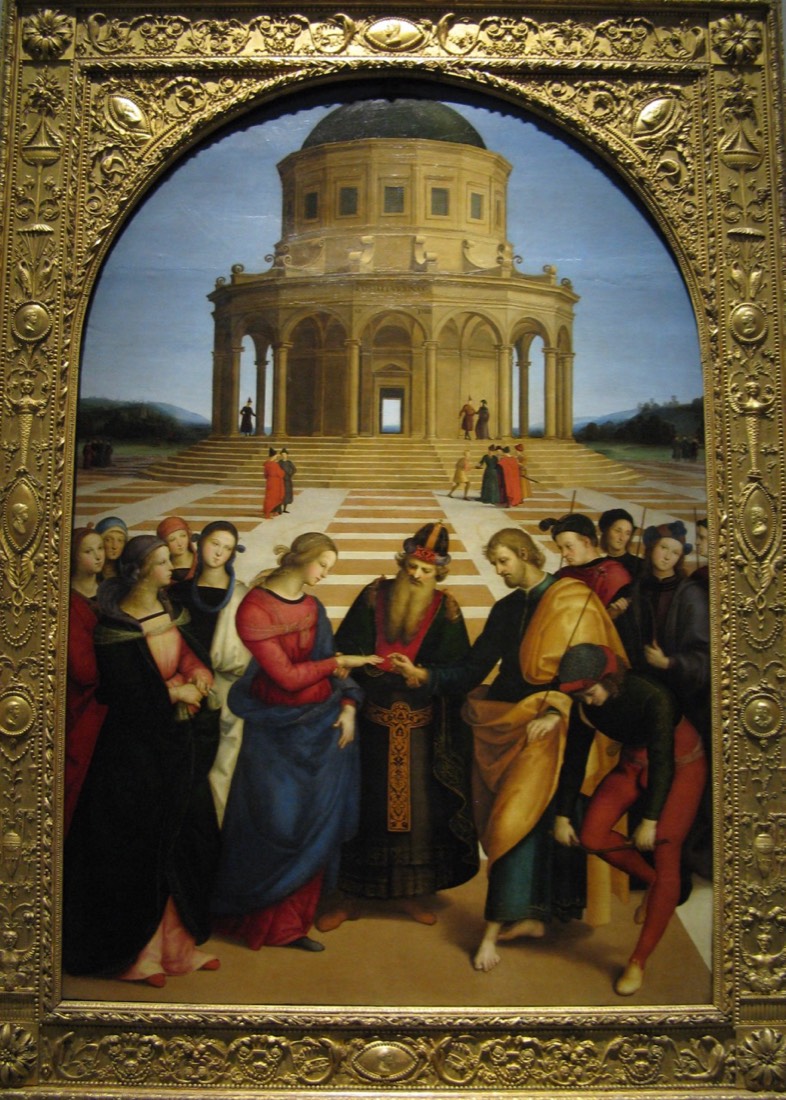
The Sposalizio della Vergine (The Marriage of the Virgin), painted by Raphael in 1504, shows the high priest joining Mary and Joseph before a circular temple in the antique style, while a rejected suitor snaps his withered branch in frustration in the foreground. Raphael finishes this painting just before leaving Umbria for Florence, at the age of twenty-one, with an almost identical Sposalizio by his master Perugino before his eyes, now held at the Musée des Beaux-Arts in Caen — same subject, same temple in the background, same general arrangement of figures. But Raphael tightens the space, gives the poses more freedom and naturalness, and achieves an effect of depth that Perugino's flatter version does not reach.
In 2016 the Pinacoteca di Brera staged an exhibition placing the two paintings directly side by side, reunited for the first time in centuries — a way of settling, visually, a debate that has run since Vasari's time over exactly what Raphael owed his master.
2. Stolen by an officer, saved by a viceroy
The painting originally hung in the Church of San Francesco in Città di Castello, Umbria. An officer of Napoleon's troops has it removed from the church and sells it in Milan for a considerable sum — an ordinary episode within the great wave of confiscations that emptied Italian churches of their masterpieces during this period. It was Eugène de Beauharnais, Viceroy of Italy and Napoleon's stepson, who recognised the painting's exceptional value and destined it for the future Pinacoteca di Brera, where it was shown at the museum's inauguration on 15 August 1809.
The painting therefore never returned to Umbria: what began as wartime plunder became, two centuries later, one of the most visited works in Milan.
3. The Montefeltro Altarpiece, Piero della Francesca and the duke's tomb
The Montefeltro Altarpiece (Madonna and Child with Saints, Angels and Federico da Montefeltro), painted by Piero della Francesca between 1472 and 1474, shows the Virgin enthroned at the centre holding the sleeping Child, surrounded by six saints — John the Baptist, Bernardine, Jerome, Francis, Peter Martyr and John the Evangelist — and archangels, while Federico da Montefeltro, dressed as a military commander, kneels before the holy group. An ostrich egg hangs above the scene, at once a symbol of Mary's miraculous motherhood and a Montefeltro heraldic emblem; the sleeping Child alludes as much to motherhood as to death, which has led some historians to read the painting as intended for a funerary purpose.
The panel was painted for the Church of San Bernardino in Urbino, which Federico da Montefeltro had built to house his own tomb. Like the Sposalizio, it was removed from its original church and transferred to Milan during the Napoleonic requisitions of the early nineteenth century — the two paintings sharing, beyond their Marian subject and their link to Urbino, an identical history of plunder.
4. Bramante in Room XXIV, Signorelli in Room V
Christ at the Column, painted around 1490 and attributed to Bramante — the attribution remains disputed, with some historians favouring Bramantino — is the only known panel painting by the architect-painter from the Urbino region. Commissioned by the Abbey of Chiaravalle near Milan, it stayed there until 1915, when it joined Brera on deposit, the abbey keeping a copy for itself. Christ, bound to a pillar carved with classical reliefs before the scourging, is shown in close-up, under double lighting, frontal and from a window in the background; a golden pyx resting on that window's sill refers to the Eucharist. In January 2017 a heating malfunction at the Pinacoteca damaged this canvas along with some forty other works; restored, it returned to Room XXIV in June of that year.
Not far away, in Room V, Luca Signorelli's Nursing Madonna and Flagellation (about 1482-1485, tempera on panel, 84 × 60 cm each) are the two sides of a processional standard made for the Raccomandati confraternity of Santa Maria del Mercato in Fabriano; they reached Brera already separated, after the Napoleonic dissolutions of 1811. The nursing Virgin reflects the confraternity's charitable work with abandoned children. A pupil of Piero della Francesca, Signorelli organises the Flagellation according to the rules of perspective around a central column, but adds "a vibrant and nervous line" that owes something to Pollaiuolo and Botticelli. Taken together, Room XXIV does not tell only the story of a pupil surpassing his master: within a few square metres it brings together three of the artists who did the most for the artistic reputation of that small Italian court.
5. Room XXVII — Genga and Bronzino, the route to Urbino continues
Girolamo Genga's Disputation over the Immaculate Conception, painted between 1516 and 1518, shows God the Father surrounded by angels above the Madonna and Child with the young Saint John the Baptist, surrounded by six saints and Church fathers debating the doctrine of the Immaculate Conception. Genga, born near Urbino, trained from the age of thirteen under Luca Signorelli in Orvieto — the same Signorelli whose standard is displayed in Room V — before spending three years with Perugino, in the company of Raphael himself. Back in Urbino, he worked for the dukes Guidobaldo da Montefeltro and then Francesco Maria della Rovere, directly extending the Montefeltro lineage of the neighbouring room. This panel, originally from the high altar of Sant'Agostino in Cesena, also reached Brera through the Napoleonic requisitions of 1809 — the third work on this route to share that history of plunder.
Agnolo Bronzino's Portrait of Andrea Doria as Neptune, painted around 1530-1540, shows the Genoese admiral nude, draped in a sail that conceals almost nothing, standing on the deck of his ship as Neptune would upon his chariot. Commissioned around 1530 by the bishop and collector Paolo Giovio for his "museum of famous men," the painting originally showed Doria holding an oar, a symbol of naval command — later replaced by an unknown hand with a trident, to sharpen the parallel with the sea god. Painted only a few years after the Sposalizio and the Montefeltro Altarpiece, this portrait carries the same route into an entirely different world: Florentine Mannerism and the allegory of power.
6. Room X — Bramante the fresco painter in Milan, and Foppa
In Room X, two fragments of frescoes by Bramante show the architect-painter in Milan: Man with Halberd (about 1486, fresco transferred to canvas, 95 × 115 cm) and The Chanter (1490-1492, fresco transferred to canvas, 120 × 126 cm). Detached from their wall and moved onto canvas, they were able to survive and enter the Pinacoteca’s collections.
Vincenzo Foppa’s Martyrdom of Saint Sebastian (1485-1490, fresco transferred to canvas, 265 × 170 cm) was detached in 1808 from the first altar on the left in Santa Maria di Brera. The museum sees in it an echo of Bramante’s perspective techniques and classical taste: monumental architecture with a perspective more scenographic than rigorous, a saint whose pose recalls antique sculpture, executioners’ faces marked by Leonardo. Visible incisions in the plaster reveal the working process, notably in the saint’s right arm.
How much time
Ten works spread across four rooms, each worth a stop: allow a little over an hour for all of it; about fifteen minutes is enough if you stop only at the Sposalizio.
- Background on the room and the Urbino court — 5 minutes.
- The Sposalizio della Vergine (Raphael) — 10 minutes.
- The story of the Napoleonic theft — 6 minutes.
- The Montefeltro Altarpiece (Piero della Francesca) — 10 minutes.
- Christ at the Column (Bramante) — 8 minutes.
- Madonna and Child, or the Nursing Madonna (Signorelli, Room V) — 6 minutes.
- The Flagellation (Signorelli, Room V) — 4 minutes.
- The Disputation over the Immaculate Conception (Genga) — 7 minutes.
- Portrait of Andrea Doria as Neptune (Bronzino) — 7 minutes.
- Man with Halberd (Bramante, Room X) — 4 minutes.
- The Chanter (Bramante, Room X) — 4 minutes.
- Martyrdom of Saint Sebastian (Foppa, Room X) — 5 minutes.
Sources and verification
Checked against the official notices of the Pinacoteca di Brera (pinacotecabrera.org) and cross-checked with Wikipedia EN/FR.
- Pinacoteca di Brera — The Marriage of the Virgin, Raphael
- Pinacoteca di Brera — Perugino and Raphael, the Marriage of the Virgin: a dialogue between master and pupil
- DailyArt Magazine — The Marriage of the Virgin: Comparison Between Raphael and Perugino
- Humanitas in Brera — Sposalizio della Vergine
- Pinacoteca di Brera — Madonna and Child with Saints, Angels and Federico da Montefeltro (San Bernardino Altarpiece), Piero della Francesca (Room XXIV)
- Wikipedia IT — Pala di Brera
- Wikipedia EN — Christ at the Column (Bramante)
- BreraPlus — The Raphael Room and More
- Pinacoteca di Brera — 10 Masterpieces for you (audio guide, room list)
- Pinacoteca di Brera — Disputation over the Immaculate Conception, Girolamo Genga (Room XXVII)
- Wikipedia EN — Girolamo Genga
- Wikipedia EN — Portrait of Andrea Doria as Neptune
- Pinacoteca di Brera — Nursing Madonna, Signorelli (Sala V)
- Pinacoteca di Brera — Flagellation, Signorelli (Sala V)
- Pinacoteca di Brera — Christ Tied to the Column, Bramante (Sala XXIV)
- Pinacoteca di Brera — Man with Halberd, Bramante (Sala X)
- Pinacoteca di Brera — The Chanter, Bramante (Sala X)
- Pinacoteca di Brera — Martyrdom of St. Sebastian, Foppa (Sala X)
Displays and room openings can change. Check the Pinacoteca di Brera website on the day of your visit before following a route.
Continue your visit
Pinacoteca di Brera, Milan
Listen to the commentary in the gallery
This route gives you a thread to follow. In front of an artwork, CulturAll adds the audio commentary: photograph the work or its label, listen, then ask your questions.

