
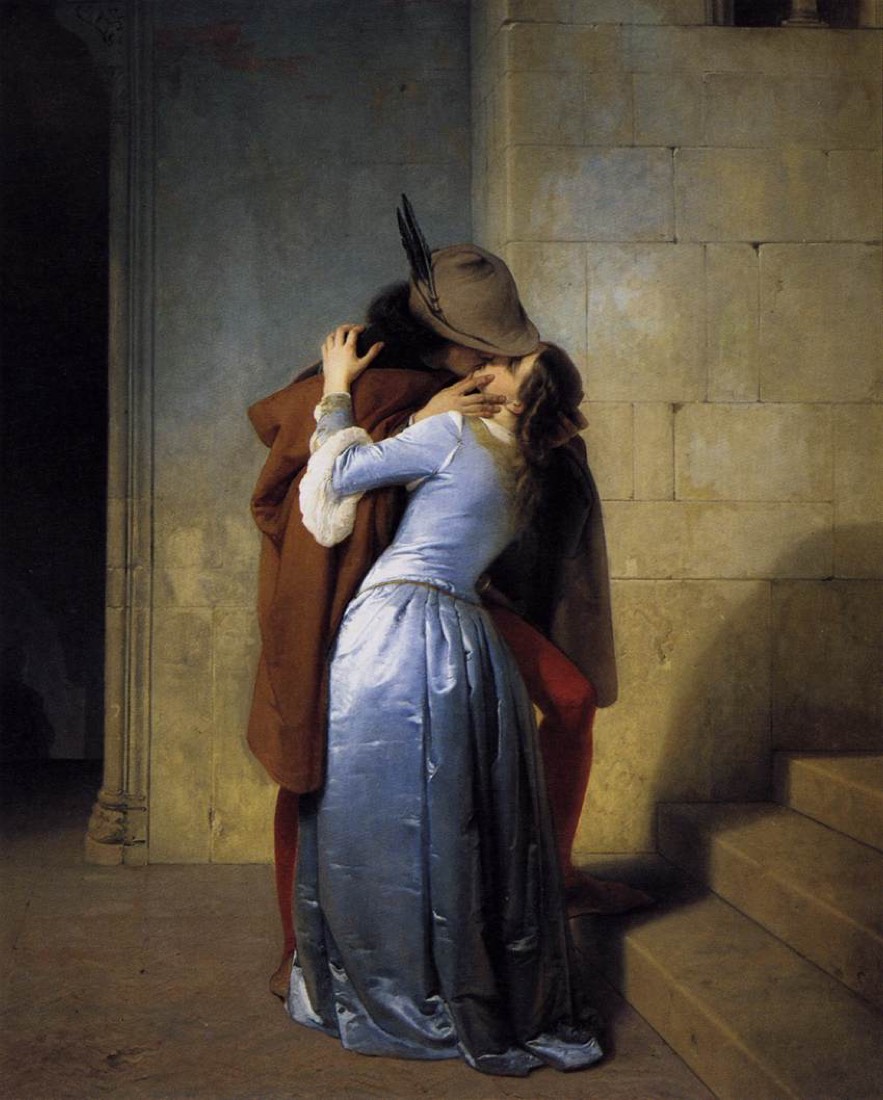

Painting the Middle Ages to talk about his own century
Francesco Hayez paints Il Bacio (The Kiss) in 1859, in an Italy still divided into several states under foreign influence or rule, in the middle of a period of repression of nationalist movements by the Austrian occupier in Lombardy. Showing ideas of Italian unity or independence directly amounted to a punishable provocation at the time; Hayez therefore chooses to wrap them in a costumed scene, a couple kissing in medieval dress, in the corner of a stone staircase. Rooms 37 and 38 at Brera, devoted to nineteenth-century Italian painting, go on to show how this generation of painters — from Hayez to Fattori — kept telling Italy's story long after 1859.
1. A farewell kiss, not a declaration
The young man has one foot resting on the first step, ready to leave, one leg already turned toward the exit — this is not a kiss of reunion but a farewell, that of a man about to join a fight. In the shadows of the staircase, on the left, a hooded figure watches the scene, and it is unclear whether he is an ally or a threat. The colours Hayez chooses — the green of the dress, the white of the lining, the red of the hose — quietly echo those of the Italian flag, a tricolour then banned in the states under Austrian control.
This patriotic reading has never been confirmed by any writing from Hayez himself explaining his exact intention, but it took hold very early in the painting's reception and remains the interpretation favoured by the museum today.
2. Three kisses, not one
Hayez paints two further versions of the same subject after the one in Brera: one in 1861 for the Mylius family, in which the young woman's dress becomes white rather than blue, and a third in 1867, with a veil added on the staircase, which the painter kept with him until his death — a sign that this was probably the version he remained most attached to. Only the 1859 version, the first and best known, is at the Pinacoteca di Brera.
3. Room 38 — Lega's Pergola, the other nineteenth century
Hanging in the same room as The Kiss, The Pergola (originally titled An Afternoon, or Un dopo pranzo) by Silvestro Lega, painted in 1868, shows a group of women talking quietly in the shade of a thick pergola, waiting for a maid to bring them coffee on a tray. Lega belonged to the Macchiaioli, Tuscan painters who laid down colour in broad patches (macchie) rather than finished drawing, aiming to capture light rather than detail. The painting, given to the Pinacoteca in 1931 by the Associazione Amici di Brera, is based on two preparatory studies now held in private collections.
The confrontation with The Kiss, a few steps away, is direct: where Hayez stages a political allegory in medieval costume, Lega paints a contemporary domestic scene with no hidden subtext at all — the two canvases, painted nine years apart, embody two opposite answers to the same question of what Italian painting should show after unification.
4. Room 37 — Molteni versus Hayez, a different rivalry
Room 37 at Brera is partly devoted to Giuseppe Molteni, a Milanese portraitist who was, in his lifetime, Hayez's great rival at the Brera annual exhibitions — a more worldly, less political rival, but just as sought after by patrons. His Portrait of the Singer Giuditta Pasta, painted in 1829, shows her in stage costume as Nina, the heroine of Paisiello's opera Nina, or the Girl Driven Mad by Love, seated in a garden, a bouquet in hand, a bagpipe player silhouetted in the landscape behind her.
La Derelitta, painted by Molteni in 1845, takes an entirely different register: a young woman in mourning, standing in a modest room, a wreath of flowers in her hand, her gaze turned upward, while an adjoining room sunk in shadow reveals a small coffin lit by candlelight. Molteni, known for his meticulous rendering of fabric and jewellery rather than grand history painting, applies that same eye for detail to an intimate, popular subject of grief — the opposite of the heroic breath Hayez reserves for his own canvases.
5. Rooms 37-38 — Fattori, Tuscany after the Risorgimento
The Rest (also known as The Red Cart), painted by Giovanni Fattori in 1887 and entering Brera in 1937 via the Riccardo Gualino collection, closes this journey through nineteenth-century Italian painting. The canvas shows an exhausted farmer sitting in a field after unyoking his oxen, on a crushing summer afternoon in the Tuscan Maremma; the composition arranges a red cart, a yellow field and the blue sea beyond along a diagonal. Fattori, one of the leading painters of the Macchiaioli alongside Lega, considered this one of his finest works.
From 1859 to 1887, from Hayez's Kiss to Fattori's Rest, Rooms 37 and 38 at Brera trace, without ever saying so directly, the passage from an Italy still dreaming its unity in medieval costume to a rural, unified Italy already nostalgic for itself.
6. Room 38 — Induno, a Bacio within the painting
Doleful Premonition by Girolamo Induno, painted in 1862, shows a dishevelled young woman sitting on the edge of a bed in a room bathed in morning light, anxiously looking at a photograph — likely that of a soldier gone to fight. On the wall just above her hangs a copy of Hayez's The Kiss; in a niche at the centre of the composition, a small plaster bust of Garibaldi; on the window shutter, a print showing Garibaldi's Redshirts waving the tricolour flag.
Induno and his brother Domenico, both painters and supporters of Garibaldi, were among the leading exponents of a genre painting that used intimate, domestic scenes to bring the Risorgimento within reach of a wider public than that of grand history paintings. By painting a reproduction of The Kiss into his own canvas, hung in the very same Room 38 as the original, Induno closes this room's loop on itself: one painting talking about another, a few metres away.
7. Rooms XXXVII and XXXVIII — Hayez as portraitist and melancholic
In Room XXXVIII, the Portrait of Alessandro Manzoni (1841, oil on canvas, 120 × 92.5 cm) was commissioned by the writer’s second wife, Teresa; the museum calls it the best-known portrait of the Milanese author, the result of fifteen sittings and “subtle psychological investigation.” Donated to Brera in 1900 by Stefano Stampa, Manzoni’s stepson, it has a later replica in Milan’s Galleria d’Arte Moderna.
In Room XXXVII, Melancholy (1841-1842, oil on canvas, 138 × 101 cm) was commissioned by Marquis Filippo Ala Ponzoni, a Mazzinian patriot and patron, and bequeathed to Brera in 1889. Hayez draws on sixteenth-century Veneto painting — the treatment of the clothing echoes Savoldo and Titian — and on Flemish still-life conventions, but favours introspection over historical narrative; the wilting flowers speak of life’s transience. The painting became one of the emblems of Romantic restlessness.
How much time
Six works in two neighbouring rooms: allow close to an hour for all of it; about fifteen minutes is enough if you stop only at Il Bacio and its three details that change everything — the foot already turned toward the exit, the figure in the shadows, and the flag colours hidden in the clothing.
- Background on Hayez and the Risorgimento — 5 minutes.
- Il Bacio, the political reading — 6 minutes.
- The three versions of The Kiss — 6 minutes.
- The Pergola (Lega) — 8 minutes.
- Portrait of Giuditta Pasta (Molteni) — 6 minutes.
- La Derelitta (Molteni) — 6 minutes.
- The Rest, The Red Cart (Fattori) — 8 minutes.
- Doleful Premonition (Induno) — 7 minutes.
- Portrait of Alessandro Manzoni (Hayez, Room 38) — 6 minutes.
- Melancholy (Hayez, Room 37) — 6 minutes.
Sources and verification
Checked against the official notices of the Pinacoteca di Brera (pinacotecabrera.org) and cross-checked with Wikipedia EN/FR.
- Pinacoteca di Brera — The Kiss, Francesco Hayez
- Wikipedia EN — The Kiss (Hayez)
- Art+Plus — Hayez's Kiss, one of the symbols of the Italian Risorgimento
- Humanitas in Brera — Il pergolato, Silvestro Lega
- Wikipedia IT — Il pergolato
- Analisi dell'Opera — Ritratto della cantante Giuditta Pasta, Molteni
- Analisi dell'Opera — La derelitta, Giuseppe Molteni
- Wikipedia EN — The Rest (The Red Cart), Giovanni Fattori
- Arte.it — Ingres e Hayez: riparte dall'Ottocento il futuro di Brera (Rooms 37-38)
- Pinacoteca di Brera — Doleful Premonition, Gerolamo Induno (Room 38)
- Wikipedia IT — Triste presentimento
- Pinacoteca di Brera — Portrait of Alessandro Manzoni, Hayez (Sala XXXVIII)
- Pinacoteca di Brera — Melancholy, Hayez (Sala XXXVII)
Displays and room openings can change. Check the Pinacoteca di Brera website on the day of your visit before following a route.
Continue your visit
Pinacoteca di Brera, Milan
Listen to the commentary in the gallery
This route gives you a thread to follow. In front of an artwork, CulturAll adds the audio commentary: photograph the work or its label, listen, then ask your questions.

