

A marriage that brought a genius into the family
In 1453, Andrea Mantegna marries Nicolosia Bellini, daughter of the painter Jacopo Bellini and sister of another painter, Giovanni. The marriage was probably arranged by Jacopo himself, eager to bring this young Paduan prodigy into Venice's most influential family workshop. Mantegna then settles in Mantua as early as 1460, but the intellectual exchange between the two brothers-in-law continues across the distance, each observing and reworking the other's inventions throughout his career.
1. Room VI — Mantegna: a body seen from the feet, and an evangelist at the start of his career
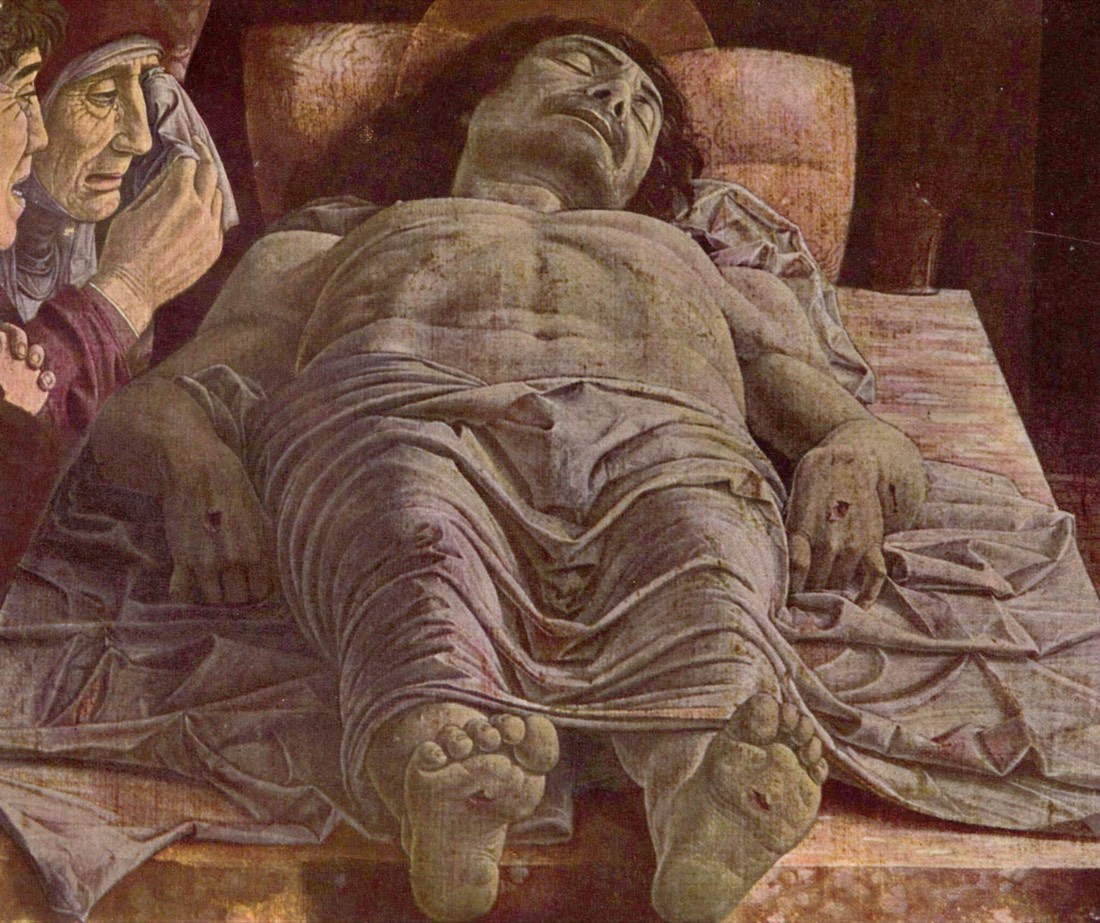
Mantegna's Dead Christ, painted around 1483, shows the body of Christ laid out on a funerary slab, seen almost directly from the soles of the feet — a foreshortening so radical that it deliberately compresses and distorts the real proportions to keep the composition legible. This was probably not an outside commission: the strongest hypothesis identifies this panel with the "foreshortened Christ" found in Mantegna's studio at his death in 1506, sold by his son Ludovico to Cardinal Sigismondo Gonzaga, before entering the collections of the lords of Mantua. Look closely at the pierced feet and the bloodless faces of the Virgin and Saint John, crowded into the left corner: Mantegna is not seeking consolation, he is seeking the frontal shock of a corpse exposed without mercy.
The Saint Luke Polyptych, painted between 1453 and 1454, belongs to an entirely different stage of Mantegna's life: he finished it the very year he married Nicolosia, for the Chapel of Saint Luke at the Benedictine abbey of Santa Giustina in Padua. Eleven panels make up the whole; at the centre, Saint Luke sits on a marble throne carved with dolphins, absorbed in writing his Gospel on a tilted lectern. It is one of the young Mantegna's very first major commissions, carried out alongside the frescoes of the Ovetari Chapel — the same perspectival virtuosity as the Dead Christ, applied here to a work still close to the Gothic polyptych tradition.
2. Room VI — Bellini: tenderness, before mourning
Giovanni Bellini's Pietà, painted around 1460 — so before his brother-in-law's Dead Christ — takes the opposite path from Mantegna: the Virgin presses her cheek against her dead son's, in a gesture of almost unbearable intimacy, with no spectacular perspective trick at all. An inscription painted on the parapet, borrowed from a poem, warns the viewer: when these eyes swollen with tears could still stir groans, this work drew sighs from Bellini himself.
The Greek Madonna, painted around 1460-1465, owes its name to a few Greek letters painted in the background. The Virgin leans slightly toward the Child she holds close, in a composition close to another Bellini Madonna held at the National Gallery in Washington. Arrived at Brera in 1808 from the Regolatori office of the Doge's Palace in Venice, this panel shows that the physical tenderness of the Pietà was not reserved for mourning: Bellini finds it intact the moment he paints a living mother and child.
3. Room VII — Carpaccio and the cycle of the Virgin
Vittore Carpaccio's Presentation of the Virgin in the Temple, painted around 1502-1505, shows the young Mary climbing the Temple steps with an almost adult determination, while the priest waits for her at the top and Joachim and Anne watch her leave from the bottom of the composition. The painting belonged, together with the Marriage of the Virgin held in the same room, to a cycle of Stories of the Virgin commissioned by the Venetian confraternity of the Albanesi.
The Marriage of the Virgin, painted around 1504-1508 for the same cycle, stages the apocryphal episode of Joseph's selection among Mary's suitors: inside a temple decorated with a menorah, Joseph is declared the winner while the rejected suitors snap their staffs in disappointment — each staff a symbol of his candidacy. Seen side by side, the two canvases tell the same story a few years apart, with the same Venetian eye for architectural detail and crowded, varied figures that made Carpaccio's reputation.
4. Room VIII — the last Bellini, and a monumental canvas
Not far away, a Madonna and Child by Bellini dated 1510 — signed and dated on a stone in the foreground, next to a reclining cheetah — closes the loop opened by the Pietà in Room VI: Bellini is by then past eighty, four years after Mantegna's death, and yet still absorbing the innovations of the following generation of painters. A restoration carried out in 1986-1987 revealed that there was no preparatory drawing under the background landscape, and that he applied paint directly with his fingertips in places. Between this canvas and the Pietà of his youth lies half a century — the two Bellinis these rooms let you see side by side.
In the same Room VIII, the monumental Saint Mark Preaching in Alexandria (1504-1507, oil on canvas, 347 × 770 cm) was commissioned from Gentile Bellini in 1504 for the reception room of the Scuola Grande di San Marco in Venice. Gentile died in 1507 with the work unfinished, and his brother Giovanni completed it, as Gentile’s will requested. Scholars debate each brother’s share: Gentile probably set out the main structure, blending Venetian architecture with Mediterranean and Oriental elements — obelisks, minarets — familiar to him from his 1497 diplomatic mission to Constantinople under Mehmed II; Giovanni probably contributed the intense portraits of the members of the confraternity on the left.
How much time
Three neighbouring rooms, eight works: allow about an hour for all of it; about fifteen minutes is enough if you compare only the two Dead Christs and the two Pietà/Madonnas in Room VI.
- The Dead Christ (Mantegna) — 8 minutes.
- The Saint Luke Polyptych (Mantegna) — 7 minutes.
- The Pietà (Bellini) — 8 minutes.
- The Greek Madonna (Bellini) — 7 minutes.
- The Presentation of the Virgin in the Temple (Carpaccio) — 8 minutes.
- The Marriage of the Virgin (Carpaccio) — 7 minutes.
- Madonna and Child, 1510 (Bellini) — 7 minutes.
- Saint Mark Preaching in Alexandria (Gentile and Giovanni Bellini) — 8 minutes.
Sources and verification
Checked against the official notices of the Pinacoteca di Brera (pinacotecabrera.org) and cross-checked with Wikipedia EN/FR/IT.
- Pinacoteca di Brera — Lamentation over the Dead Christ, Mantegna
- Wikipedia EN — Lamentation of Christ (Mantegna)
- Art & Object — Mantegna and Bellini: Sibling Rivalry in the Venetian Renaissance
- Wikipedia EN — Andrea Mantegna
- Pinacoteca di Brera — Saint Luke Polyptych, Mantegna (Room VI)
- Wikipedia IT — Polittico di san Luca
- BreraPlus — Madonna and Child (The Greek Madonna), Bellini
- Pinacoteca di Brera — Presentation of the Virgin in the Temple, Carpaccio (Room VII)
- Wikipedia IT — Storie della Vergine (Carpaccio)
- Pinacoteca di Brera — Marriage of the Virgin, Carpaccio (Room VII)
- Pinacoteca di Brera — St. Mark Preaching in Alexandria, Gentile and Giovanni Bellini (Sala VIII)
- Wikipedia EN — Madonna and Child (Bellini, Milan, 1510)
- Wikipedia IT — Pinacoteca di Brera (rooms)
Displays and room openings can change. Check the Pinacoteca di Brera website on the day of your visit before following a route.
Continue your visit
Pinacoteca di Brera, Milan
Listen to the commentary in the gallery
This route gives you a thread to follow. In front of an artwork, CulturAll adds the audio commentary: photograph the work or its label, listen, then ask your questions.

