

An anxious America, 1930s to 1940s
This room brings together American paintings made between the Great Depression and the Second World War, a period when several artists moved away from the optimism of American Scene painting toward a darker, at times almost hallucinatory, view of urban loneliness, war and the passage of time.
1. A blackout turned into a painting
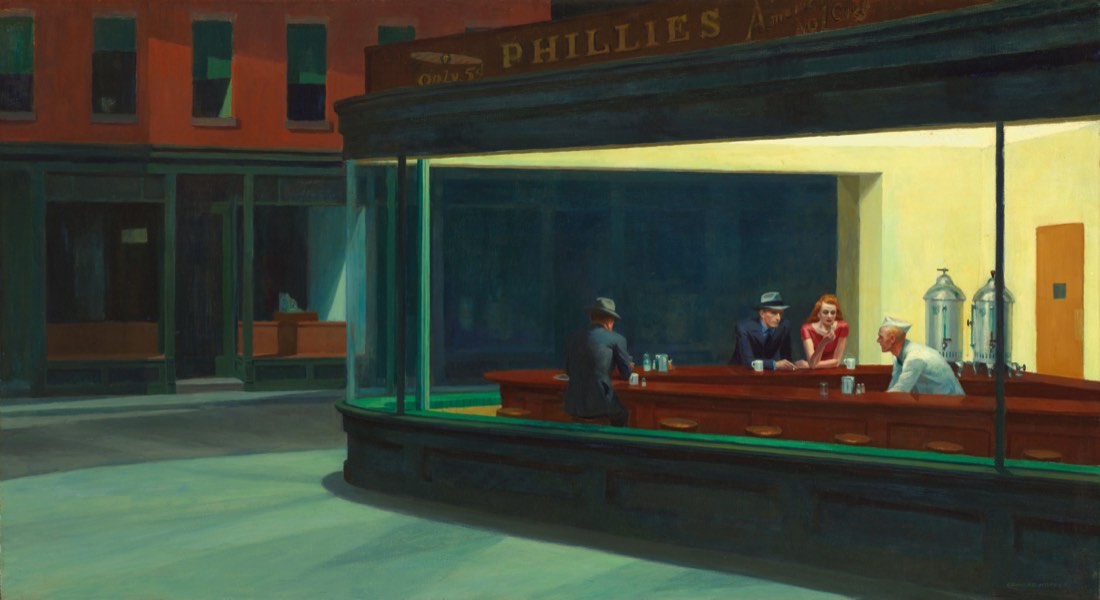
Nighthawks, finished by Edward Hopper on 21 January 1942, shows three late customers in a neon-lit diner at the corner of two empty streets. Hopper said he was inspired by a real restaurant on Greenwich Avenue in New York, but the painting's atmosphere owes much to the months following the attack on Pearl Harbor in December 1941: Hopper, struck at the time by blackout drills and the near-total darkness settling over the city's streets at night, carried that unusual darkness into the composition.
The red-haired woman in the painting was modeled by Josephine Nivison Hopper, the painter's wife and a painter herself, who kept a shared journal with him recording the progress of each canvas — which is how the exact completion date of the painting is known. The Art Institute of Chicago bought Nighthawks on 13 May 1942, for $3,000.
2. A pitiless mirror on the passage of time
Hung in the same room, Ivan Albright's Into the World There Came a Soul Called Ida, painted between 1929 and 1930, shows an aging woman facing her mirror, rendered with an almost unbearable attention to detail: every wrinkle, every age spot painted with the same clinical care. Where Hopper offers silent solitude, Albright chooses excess and accumulation to evoke the same subject — time wearing down bodies and lives.
3. Blume and Guglielmi, ruins and waiting
Peter Blume's The Rock, painted between 1944 and 1948, shows a shattered red rock resting on a base that workers below are demolishing. Commissioned in 1939 by the Kaufmann family for their Pennsylvania residence, the canvas took Blume years to complete; its layered imagery evokes devastation and reconstruction, echoing the upheavals of the Second World War and its aftermath — but the finished painting turned out too large for its intended spot and was never installed there.
O. Louis Guglielmi's The River, painted in 1942, shows seven women and a child watching a stretch of shimmering water that contrasts with an industrial landscape behind them, dressed in the modest clothes of the working class during their leisure time. Guglielmi uses the scene to point to the hardships of ordinary workers during the Great Depression and the rise of fascism; painted in the middle of the war, at a moment when women dominated urban space while men served abroad, the painting captures the daily monotony of a country at war.
4. Charles White, hope rising from the rubble
Charles White's This, My Brother, painted in 1942, shows a man with outstretched arms rising from demolished rubble. White, a Chicago-based artist, made the painting a statement on racial equality and social change: he adapted his protagonist from a 1936 novel about a white coal miner's political awakening, reimagining the figure as a Black man breaking free from destruction — a symbol of hope for social transformation. White summed up his practice this way: "Paint is the only weapon I have with which to fight what I resent."
5. Sheeler, the self-portrait that refuses to look
Charles Sheeler's The Artist Looks at Nature, painted in 1943, is a paradoxical self-portrait: despite its title, Sheeler shows himself seated at his easel, ignoring the brightly lit landscape stretching before him, focused instead on sketching an old stove — drawn from a photograph he had taken himself in 1917. By reconstructing elements of his own artistic past this way, blending photography and painting, Sheeler creates something new and almost surreal in the present — a gesture whose exact meaning stays deliberately ambiguous.
6. Shahn and Lewis, two recent additions to the same unease
Ben Shahn's Contemporary American Sculpture, painted in 1940, stages a fictional sculpture exhibition at the Whitney Museum: three images hung on the back wall, which appear to be paintings on display, are actually drawn from Shahn's own New Deal-era photographs of working-class Americans. Those figures can see into the gallery but remain excluded from its "real" space — a comment on race, class and exclusion in the art world, added to the museum's collection in 2023.
Norman Lewis's Multitudes, painted in 1946, layers rapid calligraphic marks over a ground of pulsating color; the dense lines evoke a crowd of figures, reflecting Lewis's interest in nonrepresentational forms tied to urban energy. The title alludes to Walt Whitman's poem Song of Myself. Lewis was the only Black member of the first generation of New York Abstract Expressionists.
How much time
Eight very different visions of mid-century American unease: allow a little over an hour to look at them all.
- Background on the room — 5 minutes.
- Nighthawks (Hopper) — 10 minutes.
- Into the World There Came a Soul Called Ida (Albright) — 8 minutes.
- The Rock (Blume) — 6 minutes.
- The River (Guglielmi) — 6 minutes.
- This, My Brother (White) — 6 minutes.
- The Artist Looks at Nature (Sheeler) — 6 minutes.
- Contemporary American Sculpture (Shahn) — 7 minutes.
- Multitudes (Lewis) — 6 minutes.
Sources and verification
Checked against the official notices of the Art Institute of Chicago (artic.edu) and cross-checked with Wikipedia EN/FR.
- Art Institute of Chicago — Gallery 262
- Art Institute of Chicago — Acquiring Nighthawks
- Art Institute of Chicago — Into the World There Came a Soul Called Ida
- WTTW Chicago — Edward Hopper's Iconic 'Nighthawks'
- Art Institute of Chicago — The Rock, Peter Blume (Gallery 262)
- Art Institute of Chicago — The River, O. Louis Guglielmi (Gallery 262)
- Art Institute of Chicago — This, My Brother, Charles White (Gallery 262)
- Art Institute of Chicago — The Artist Looks at Nature, Charles Sheeler (Gallery 262)
- Art Institute of Chicago — Contemporary American Sculpture, Ben Shahn (Gallery 262)
- Art Institute of Chicago — Multitudes, Norman Lewis (Gallery 262)
Displays and room openings can change. Check the Art Institute of Chicago website on the day of your visit before following a route.
Continue your visit
Art Institute of Chicago
Listen to the commentary in the gallery
This route gives you a thread to follow. In front of an artwork, CulturAll adds the audio commentary: photograph the work or its label, listen, then ask your questions.

