

American Scene painting between the wars
This room brings together paintings made in the 1930s and 1940s by artists associated with the American Scene movement and its edges — Mexican muralists, painters of the Great Migration, a portraitist of the macabre — who all sought to depict the country's rural and urban life in an accessible figurative style, running against the European avant-gardes of the same period.
1. A brother, a sister, and a dentist who never met
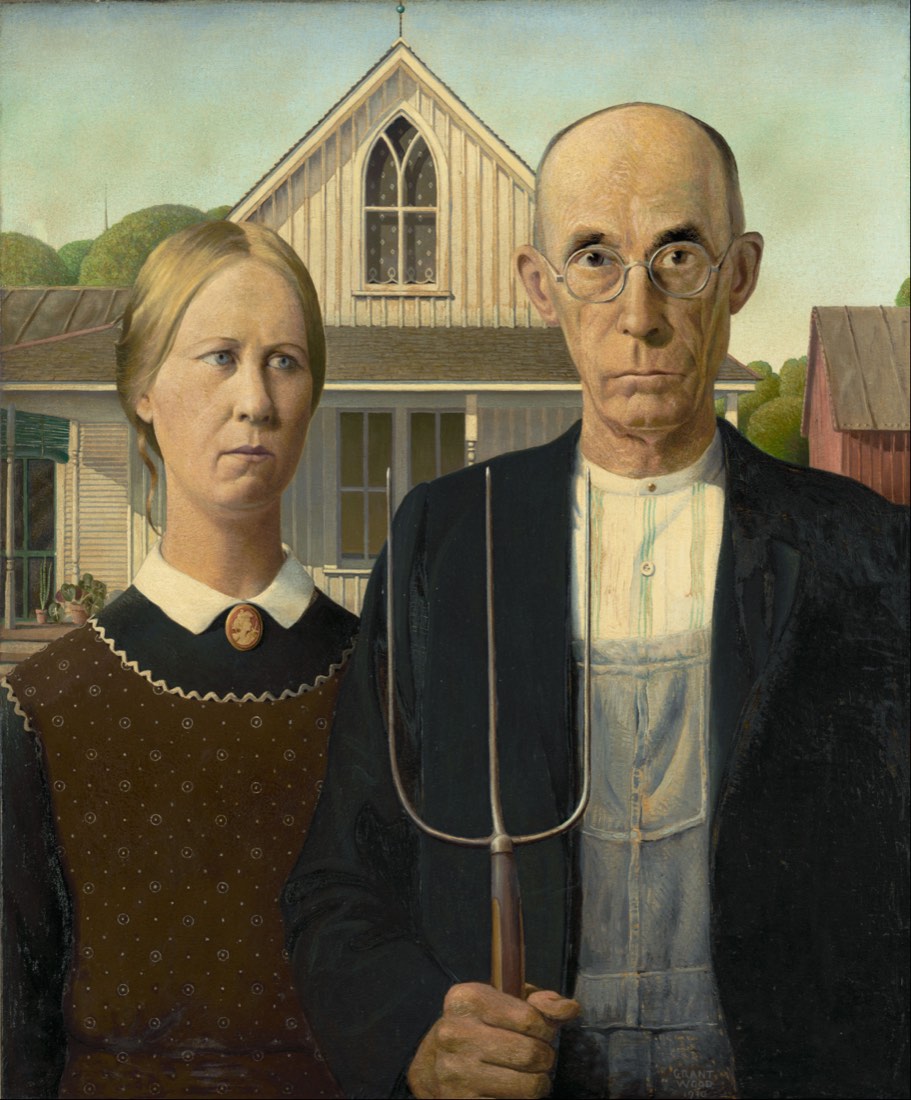
American Gothic, painted by Grant Wood in 1930, shows a farmer holding a pitchfork and a younger woman standing beside him, in front of a wood-frame house with a Gothic Revival pointed window Wood had spotted in the small town of Eldon, Iowa. To paint the two figures, Wood used his own sister, Nan Wood Graham, and his dentist, Byron McKeeby, as models — the two never met, each posing separately in the painter's studio, while the house itself was painted on a separate trip.
2. The misunderstanding that followed the painting for decades
Grant Wood always maintained that he intended to depict a father and his daughter, not a married couple — a point confirmed in a 1941 letter to a correspondent. Nan Wood Graham, embarrassed at the idea of being taken for the wife of a man twice her age, insisted on this father-daughter reading her whole life, without ever fully erasing the opposite interpretation, popularized by generations of advertising and political parodies that show the painting as the portrait of a strict, austere rural couple.
3. Zapata, the same year, an entirely different America
Zapata, painted by José Clemente Orozco in 1930 — the same year as American Gothic — shows the Mexican revolutionary Emiliano Zapata framed in a doorway, surrounded by fellow fighters and mourning figures. Orozco, one of the leading figures of Mexican mural painting, chooses violent imagery — cartridge belts slung across a shoulder, a sword pointed at an eye — to deliver an ambiguous portrait rather than a tribute: Zapata, assassinated in 1919, embodied for leftist Mexican artists the whole of the revolutionary struggle, its suffering as much as its ideals.
Painted in California, this large canvas is a reminder that the same year that produced the most peaceful image of rural America also produced one of its images most haunted by political violence, on the other side of the border.
Weaving, painted by Diego Rivera in 1936, shows Luz Jiménez, a master Nahua weaver, passing the weft through the warp on a backstrap loom, the finished part of the textile resting on her lap. Rivera, a leading modernist painter in the years after the Mexican Revolution (1910-1920), promoted a vision of national identity rooted in Indigenous and folk cultures, distinct from the legacies of Spanish colonialism; by centring Jiménez, he claimed her traditions as part of his own. This tempera and oil on canvas (66 × 106.7 cm) was bought from the artist’s studio in Mexico in 1936 by Julie F. Miller of Chicago and given to the Art Institute by her daughter in 1998.
4. Ellison and Lawrence, the Great Migration from the inside
Walter Ellison's Train Station, painted in 1935, shows a departure scene at a station, contrasting white passengers boarding southbound trains to Florida for leisure, attended by Black porters, with Black passengers heading north — to Chicago, Detroit, New York — to escape Jim Crow laws and seek better opportunities. Ellison, who himself left Georgia for Chicago around 1926 as part of the Great Migration, signs the painting with his initials on a suitcase, a quiet signature of a personal experience.
Jacob Lawrence's The Wedding, painted in 1948, shows a marriage ceremony seen from behind, guests turned toward a barely visible preacher, surrounded by urns of colourful flowers symbolising the happiness and prosperity promised to the couple. Lawrence, who would devote entire series to the Great Migration and to the story of Harriet Tubman, summed up his approach this way: "I paint the things I have experienced."
The Room No. VI, painted in Chicago in 1948 by Eldzier Cortor, who grew up and trained there, exposes the impoverished living conditions of many African Americans on the city’s South Side: because of racial bias in housing, they were often forced into “kitchenettes,” apartments subdivided into one-room units with limited access to kitchens or bathrooms. A nude woman anchors the composition, flanked by three other people whose cropped bodies extend across a single mattress; Cortor emphasizes pattern and texture — bed linens, floorboards, wallpaper — and, through a deliberately decorative vocabulary, recasts the bleak setting as a luminous composition. Oil and gesso on Masonite (106.9 × 79.9 cm).
5. Benton and Albright, labour and evil
Thomas Hart Benton's Cotton Pickers, painted in 1945 from memories of a stay in Georgia in the late 1920s, uses a sinuous, curving style to render the physical exertion of the work. The painting evokes sharecropping, an agricultural system born after the Civil War that perpetuated poverty among Black workers and became a symbol of both racial and economic injustice.
Ivan Albright's Picture of Dorian Gray, painted in 1943-44, is the corrupted portrait made for the 1945 film adaptation of Oscar Wilde's novel: as the film's protagonist sinks into depravity, it is this canvas that records, on screen, his moral decay — the only shot filmed in colour within an otherwise entirely black-and-white film. Albright, already known for his macabre style, was the obvious choice for this grotesque portrait; once exhibited at the Art Institute, the painting drew such crowds that the Chicago Tribune reported the museum "is having a heck of a time handling" them.
How much time
Look at the faces in American Gothic: nothing in either model's features actually signals a marital bond — it was the tight framing and the pose alone that created the misunderstanding. Allow about an hour for the eight works featured from the room.
- Background on the room — 5 minutes.
- American Gothic — 8 minutes.
- The father-daughter / couple misunderstanding — 6 minutes.
- Zapata (Orozco) — 6 minutes.
- Weaving (Rivera) — 6 minutes.
- Train Station (Ellison) — 6 minutes.
- The Wedding (Lawrence) — 6 minutes.
- The Room No. VI (Cortor) — 6 minutes.
- Cotton Pickers (Benton) — 6 minutes.
- Picture of Dorian Gray (Albright) — 7 minutes.
Sources and verification
Checked against the official notices of the Art Institute of Chicago (artic.edu) and cross-checked with Wikipedia EN/FR.
- Art Institute of Chicago — American Gothic, Grant Wood
- Smithsonian Magazine — Meet Grant Wood's Sister
- American Gothic House Center — The Painting
- Kottke.org — The Models for American Gothic
- Art Institute of Chicago — Zapata, José Clemente Orozco (Gallery 263)
- Art Institute of Chicago — Train Station, Walter Ellison (Gallery 263)
- Art Institute of Chicago — The Wedding, Jacob Lawrence (Gallery 263)
- Art Institute of Chicago — Cotton Pickers, Thomas Hart Benton (Gallery 263)
- Art Institute of Chicago — Picture of Dorian Gray, Ivan Albright (Gallery 263)
- Art Institute of Chicago — Weaving, Diego Rivera (Gallery 263)
- Art Institute of Chicago — The Room No. VI, Eldzier Cortor (Gallery 263)
Displays and room openings can change. Check the Art Institute of Chicago website on the day of your visit before following a route.
Continue your visit
Art Institute of Chicago
Listen to the commentary in the gallery
This route gives you a thread to follow. In front of an artwork, CulturAll adds the audio commentary: photograph the work or its label, listen, then ask your questions.

