

"Truth" versus "poetry"
John Constable and J. M. W. Turner were born a year apart (1776 and 1775) and spent their entire careers in each other's shadow, exhibited side by side at the Royal Academy for decades. Their contemporaries already set them against each other: the "truth" of the first, devoted to painting the sky and countryside of the Suffolk where he grew up, against the "poetry" of the second, drawn more to dissolving light and historical or maritime subjects. Tate devoted a major exhibition to this rivalry, Turner & Constable: Rivals & Originals (27 November 2025 – 12 April 2026); the canvases gathered here, though, belong to the museum's permanent collection and remain on view well after that temporary show closed — they are enough on their own to show the opposition between the two painters directly, wall against wall.
1. The day Turner "fired a gun"
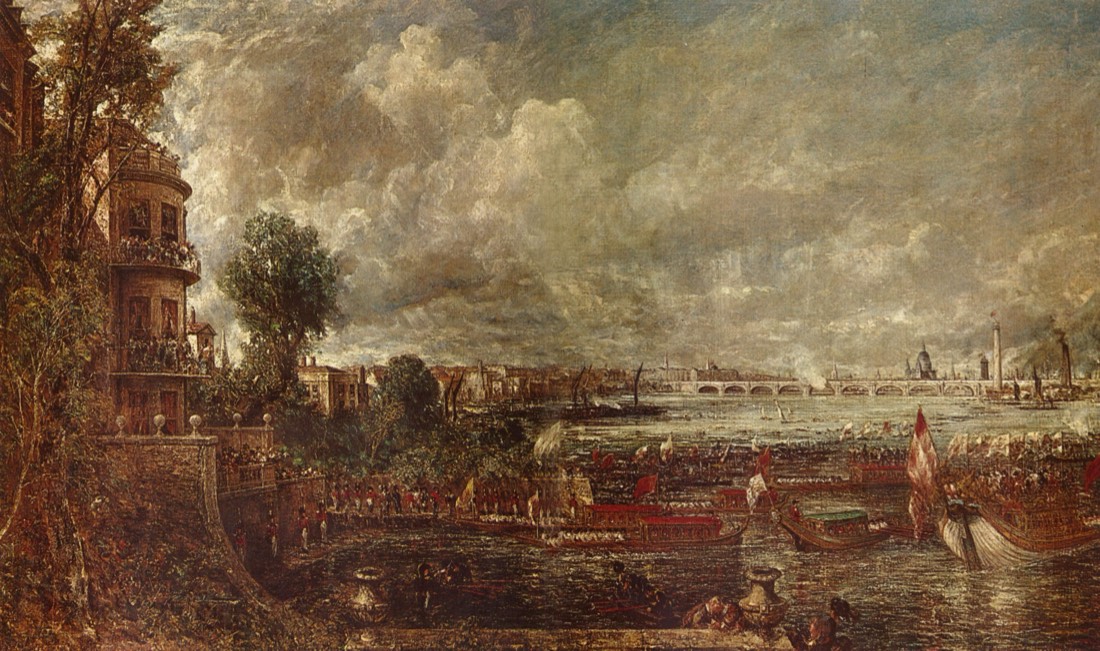
In 1832, on the eve of the Royal Academy's annual exhibition opening, Constable finishes varnishing The Opening of Waterloo Bridge, seen from Whitehall Stairs — a canvas he had worked on for over a decade, hung in a room next to a Turner seascape, Helvoetsluys. That painting is not in this room — it now belongs to a private collection in Japan — but the episode it triggered remains attached forever to the Constable canvas hanging here.
Turner, judging his own painting too grey next to the reds and golds of the Waterloo Bridge canvas, returns to his already-hung work and adds a small, bright red buoy, just enough to make his painting stand out in the middle of the room. Constable, discovering the change, is said to have remarked: "He has been here and fired a gun." Despite this apparent rivalry, the two men would occasionally dine together: Constable would soon after describe a quiet evening spent with Turner, "just the two of us."
2. Constable and the Suffolk "six-footers"
Next to the Waterloo Bridge canvas, The Leaping Horse (exhibited 1825) belongs to what Constable called his "six-footers" — large rural landscape canvases, a scale usually reserved for history painting, that he devotes instead to scenes of the Stour valley in the Suffolk where he grew up. It is a claim in itself: raising the local landscape to the rank of a grand subject, with no need for a mythological or biblical episode to justify it.
Salisbury Cathedral from the Meadows, exhibited in 1831, shows the cathedral framed by the arc of a rainbow that spans the whole canvas, beneath storm clouds crossed by a flash of lightning. Constable painted it after the death of his wife Maria in 1828; art historians often read the dark clouds as an echo of his grief, and the rainbow as a promise of consolation — a reading reinforced by a quotation from a poem by James Thomson that Constable attached to the painting when he exhibited it, describing the death of a young woman in her lover's arms.
3. Turner and the fire he watched with his own eyes
The Burning of the Houses of Lords and Commons (exhibited 1835) shows the fire that destroyed the British Parliament on 16 October 1834 — an event Turner watched in person from the bank of the Thames, sketching the scene on the spot before reworking it in the studio. The painting, its flames and their reflection on the water treated almost as pure abstraction, stands at the opposite pole from Constable's near-topographical precision in the neighbouring canvas.
Caligula's Palace and Bridge (exhibited 1831) imagines the ruins of the floating bridge the Roman emperor Caligula, according to Suetonius, had built across three miles between Baiae and Puteoli to disprove a prediction that he would never become emperor. Turner paints this bridge and the palace beside it already fallen into ruin, bathed in a hazy golden light — a meditation on the fragility of power and grand ambition, staged through an ancient subject rather than a contemporary event.
Norham Castle, Sunrise, painted around 1845, is among Turner's last paintings: a view almost entirely dissolved in dawn light, where the outline of the castle on the River Tweed, on the border between England and Scotland, can barely be made out. The painting entered the national collection in 1856, through the Turner Bequest, along with the entire contents of the painter's studio at his death.
Compare Constable's and Turner's approaches in this same room: one paints very real places with a wealth of topographical detail, the other dissolves historical or contemporary subjects almost entirely into light and atmosphere. These are two answers to the same question — how to paint England and its past — coming from two temperaments that could not have been more different.
4. Constable, the birthplace of the six-footers and a sky caught in an hour
Flatford Mill, painted in 1816-17 and exhibited at the Royal Academy in 1817, shows the water mill Constable's father owned at East Bergholt, in the Suffolk where the painter grew up and worked as a child. It is the first painting of this scale Constable showed at the Royal Academy, and art historians regard it as the founding work of the "six-footer" series that followed — of which The Leaping Horse, hanging in this same room, is one of the last examples.
Cloud Study, painted in 1822, belongs to the series of open-air oil sketches Constable made on Hampstead Heath in 1821-22, during his so-called "skying" campaign — partly inspired by the cloud classification system the meteorologist Luke Howard had just published. Constable routinely noted the time, date and weather on the back of these studies; this sheet carries two inscriptions roughly an hour apart, proof that he worked fast, outdoors, to capture a sky before it changed.
How much time
Focus on the two central works of the 1832 anecdote, then let yourself be carried from one sky and light to the next along the walls.
- The Opening of Waterloo Bridge (Constable) — 9 minutes.
- The Leaping Horse (Constable) — 7 minutes.
- Salisbury Cathedral from the Meadows (Constable) — 8 minutes.
- Flatford Mill (Constable) — 8 minutes.
- Cloud Study (Constable) — 6 minutes.
- The Burning of the Houses of Lords and Commons (Turner) — 9 minutes.
- Caligula's Palace and Bridge (Turner) — 7 minutes.
- Norham Castle, Sunrise (Turner) — 6 minutes.
Sources and verification
Checked against Tate's collection and exhibition pages (tate.org.uk) and cross-checked with Wikipedia EN/FR.
- Tate — Turner & Constable: Rivals & Originals, exhibition guide
- Tate Papers — 'Fire and Water': Turner and Constable in the Royal Academy, 1831
- The Art Newspaper — Frenemies or rivals? Tate Britain show explores Turner and Constable
- Wikipedia EN — Turner and Constable: Rivals and Originals
- Tate — John Constable, The Opening of Waterloo Bridge
- Tate — John Constable, The Leaping Horse
- Tate — J.M.W. Turner, The Burning of the Houses of Lords and Commons
- Tate — John Constable, Salisbury Cathedral from the Meadows
- Tate — J.M.W. Turner, Caligula's Palace and Bridge
- Tate — J.M.W. Turner, Norham Castle, Sunrise
- Tate — John Constable, Flatford Mill ('Scene on a Navigable River')
- Tate — John Constable, Cloud Study
Displays and room openings can change. Check the Tate Britain website on the day of your visit before following a route.
Continue your visit
Tate Britain, London
Listen to the commentary in the gallery
This route gives you a thread to follow. In front of an artwork, CulturAll adds the audio commentary: photograph the work or its label, listen, then ask your questions.

