
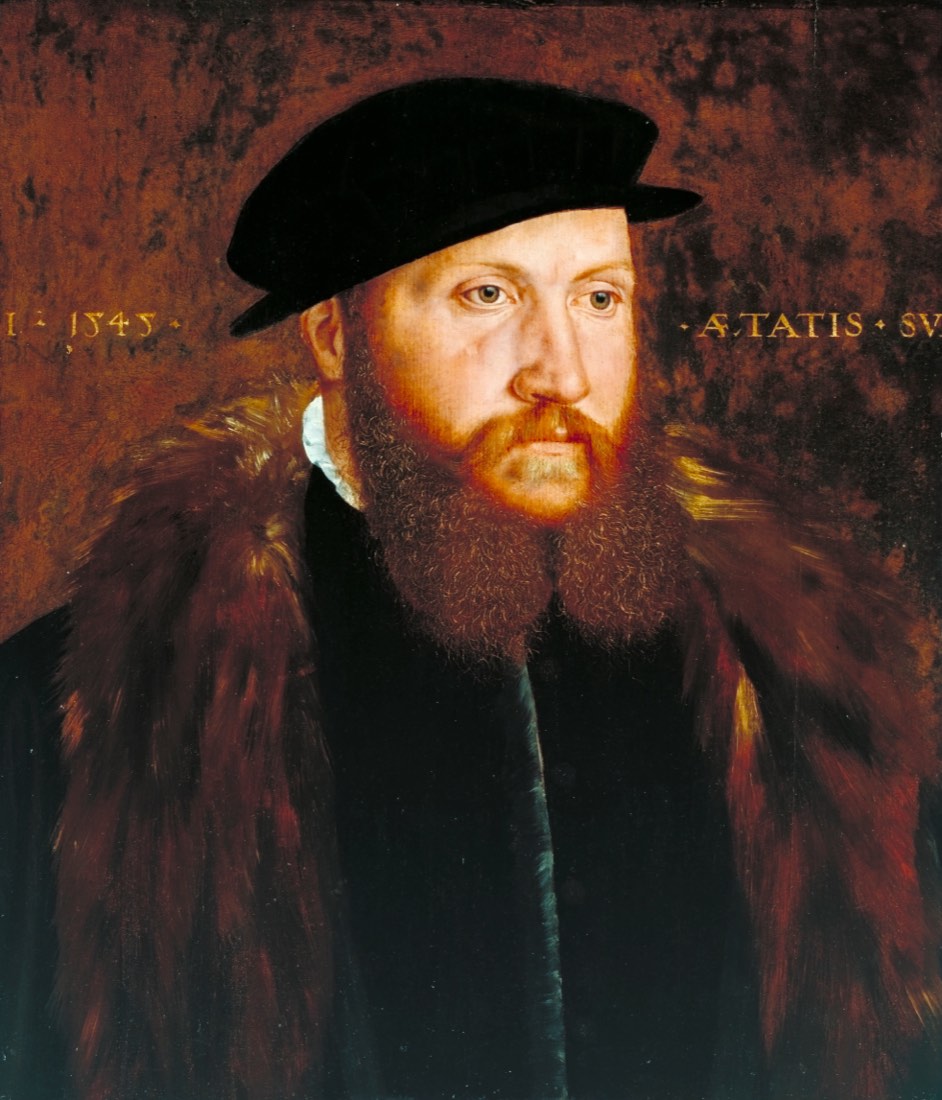

The oldest painting at Tate, surrounded by migrations
The room brings together court portraits painted between the last years of Henry VIII's reign and the reign of Charles I — nearly a century of Tudor and then Stuart dynasties told through the faces they had painted. Yet the room's guiding thread is not dynastic: it is migration. Most of the era's most sought-after court painters were immigrants from northern Europe, often having fled religious persecution.
This curatorial choice is visible even in the contemporary works placed among the older portraits: Exodus II, by Palestinian artist Mona Hatoum (2000), shows two leather suitcases joined by strands of human hair. Hatoum, whose family fled Palestine in 1948 before she herself was displaced by the Lebanese civil war in 1975, places here a contemporary object of exile amid four centuries of portraits painted by exiles of another era.
1. 1545: the oldest painting in the collection
A Man in a Black Cap, painted by John Bettes in 1545, is the oldest painting in Tate's entire collection. An inscription on the back of the oak panel states it was painted "in the year of our Lord 1545" and that the sitter was then twenty-six years old — but his identity remains unknown. The background, now a ginger-brown, was originally deep blue: Bettes used a pigment called smalt, made from ground glass, which has the property of irreversibly turning brown under the effect of light over the centuries.
Bettes's technique is so close to that of Hans Holbein the Younger — himself a German painter established in England as court portraitist to Henry VIII — that art historians believe he may have worked in his workshop. Two generations before the Flemish artists in this room, it was already a German who was defining the art of the portrait at the English court.
2. A family of painters who fled the Duke of Alba
Marcus Gheeraerts the Younger arrives in England around 1568, aged six or seven, with his father Marcus Gheeraerts the Elder — one of thousands of Flemish Protestants then fleeing the Spanish Netherlands to escape the bloody persecution led by the Duke of Alba against defectors from Catholicism. As an adult, the son becomes one of the most sought-after portraitists of the closing years of Elizabeth I's reign, under the patronage of royal tournament master Sir Henry Lee, then favoured portraitist to Anne of Denmark, wife of James I.
Gheeraerts only obtains English naturalisation in 1618 — fifty years after arriving as a child refugee, and while he had been painting the royal family for decades. His Portrait of Captain Thomas Lee (1594) is one of the room's most singular paintings: Lee, an English soldier in the Irish wars suspected of treachery to Elizabeth I, has himself painted bare-legged, blending the dress of the Irish soldier he fought against with that of a Roman hero. A Latin inscription carved into the tree behind him invokes Mucius Scaevola, the Roman who stayed loyal to Rome even as a captive of its enemies — Lee thus proclaims his own loyalty to the English crown, in the midst of controversy over his allegiances.
3. Van Dyck, the Fleming who became the English king's painter
Anthony van Dyck arrives in London in 1632 and within months becomes the official portraitist of Charles I, before being knighted by the king that same year. His Portrait of Sir William Killigrew (1638) shows this courtier and future playwright as a melancholic scholar, his gaze turned away from the viewer, leaning pensively against the base of a column — a ring tied with a ribbon to his black satin jacket suggests a token of love or of mourning. The painting originally formed a pair with the portrait of his wife Mary Hill, painted the same year.
Like Gheeraerts a generation earlier, Van Dyck imports into England a pictorial language shaped on the continent — here the lessons of Rubens and Titian — which durably redefines English court portraiture long after his death in 1641.
4. Van Somer and Mytens, two more painters from Flanders and Holland
Paul van Somer, a Flemish painter who arrived in England around 1616, quickly becomes one of the leading portraitists of James I's court. His Lady Elizabeth Grey, Countess of Kent (c.1619) depicts a former maid of honour to Elizabeth I who had become a countess, painted with the meticulous rendering of fabric and jewellery characteristic of portraitists who came from the Netherlands.
Daniel Mytens the Elder, a Dutch painter, in turn becomes the leading portraitist at the English court in the 1620s, before being eclipsed by Van Dyck on his arrival in 1632. His Portrait of James Hamilton, Earl of Arran, Aged 17 (1623) shows the new naturalism Mytens introduces into English court portraiture, a few years before Van Dyck overshadows him.
5. Two puzzles in the same room: painted twins and a ceiling never installed
The Cholmondeley Ladies, painted by an unknown artist around 1600-1610, shows two women seated up in bed, each holding a swaddled infant — a gold-lettered inscription at the bottom left states that it shows "two ladies of the Cholmondeley family, who were born the same day, married the same day, and brought to bed the same day." Painted in oil on four joined oak panels (88.6 x 172.3 cm), the picture plays on an almost perfect symmetry between the two women, distinguishable only by small details — lace, jewellery, eye colour. It entered the Tate's collection in 1955, the gift of an anonymous donor.
Nearby, The Apotheosis of James I and Other Studies: Multiple Sketch for the Banqueting House Ceiling, Whitehall, painted by Peter Paul Rubens around 1628-30, is the only known sketch for the overall composition of the ceiling Charles I commissioned from Rubens in tribute to his father James I — a cycle still in place today at the Banqueting House, Whitehall, one of the very few Rubens ceilings never to have left its original site. This oil on oak panel (94.7 x 63 cm), likely painted in London while Rubens was there as a diplomat in 1629-30, shows the king being carried up to heaven — an early set of ideas for the scheme, which Tate bought in 2008 for £5.7 million with the support of the National Heritage Memorial Fund and the Art Fund.
How much time
Take the time to spot Exodus II among the older portraits before stopping at the portraits painted by these artists from the continent: it is this juxtaposition that gives the room its meaning.
- A Man in a Black Cap (Bettes, 1545) — 7 minutes.
- Portrait of Captain Thomas Lee (Gheeraerts, 1594) — 8 minutes.
- Exodus II (Mona Hatoum) — 6 minutes.
- Portrait of Sir William Killigrew (Van Dyck, 1638) — 7 minutes.
- Lady Elizabeth Grey, Countess of Kent (Van Somer, c.1619) — 7 minutes.
- Portrait of James Hamilton, Earl of Arran (Mytens, 1623) — 7 minutes.
- The Cholmondeley Ladies — 9 minutes.
- The Apotheosis of James I (Rubens) — 9 minutes.
Sources and verification
Checked against Tate's collection pages (tate.org.uk) and cross-checked with Wikipedia EN/FR.
- Tate — A Man in a Black Cap, John Bettes
- Tate — Tudor and Stuart Technical Research, Unknown Man in a Black Cap
- Wikipedia EN — John Bettes the Elder
- Wikipedia EN — Marcus Gheeraerts the Younger
- Tate — Exodus 2, Mona Hatoum
- Tate — Portrait of Captain Thomas Lee, Marcus Gheeraerts II
- Tate — Portrait of Sir William Killigrew, Sir Anthony Van Dyck
- Tate — Lady Elizabeth Grey, Countess of Kent, Paul Van Somer
- Tate — Portrait of James Hamilton, Earl of Arran, Daniel Mytens the Elder
- Tate — Exiles and Dynasties, display
- Tate — The Cholmondeley Ladies, Unknown artist
- Tate — The Apotheosis of James I and Other Studies, Rubens
Displays and room openings can change. Check the Tate Britain website on the day of your visit before following a route.
Continue your visit
Tate Britain, London
Listen to the commentary in the gallery
This route gives you a thread to follow. In front of an artwork, CulturAll adds the audio commentary: photograph the work or its label, listen, then ask your questions.

