

A room for the history of the Royal Navy
This gallery traces the history of the British navy through its great figures and great moments, from the heroic high point embodied by Nelson to the darker episodes the institution has also chosen to display rather than erase.
1. Shot on his own deck for not "doing his utmost"
The Execution of Admiral Byng, 14 March 1757, shows the death of John Byng, shot by six marines on the deck of the flagship HMS Monarch, in Portsmouth harbour, after being found guilty of not "doing his utmost" to relieve the besieged British garrison at Minorca. According to the Monarch's log, Byng was declared dead at noon and immediately placed in his coffin.
The episode inspired one of Voltaire's most famous lines, in Candide: in England, it is thought good to kill an admiral from time to time, to encourage the others.
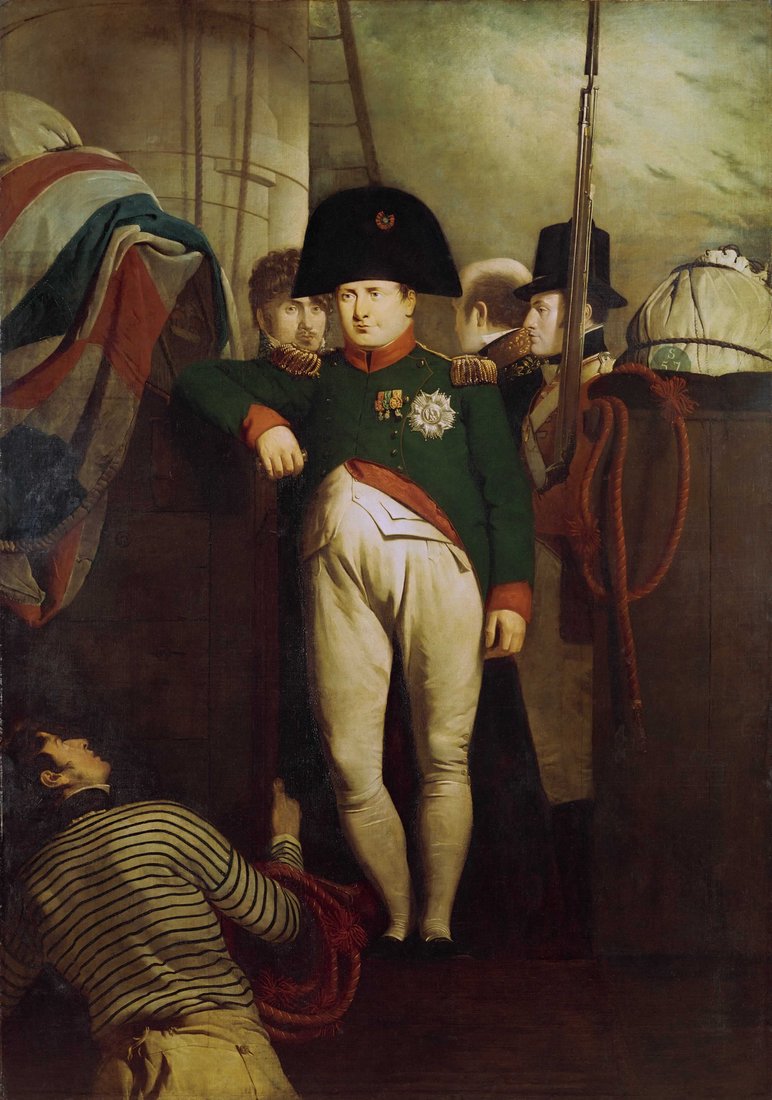
2. A defeated Napoleon, watched by hundreds of sightseers in rowing boats
Napoleon Bonaparte on Board the 'Bellerophon' in Plymouth Sound, painted by Charles Lock Eastlake in 1815, shows the deposed emperor shortly after he boarded on 15 July 1815. For several weeks, while his fate was being decided, Napoleon appeared on deck each evening around 6pm for the benefit of the many boatloads of sightseers who came out into the Sound to catch a glimpse of him — it was by watching these appearances that Eastlake, then a young painter, sketched from life the portrait that would make this painting instantly famous when it was exhibited in London.
3. Rigaud, the first portrait of Nelson ever published
Captain Horatio Nelson, 1758-1805, painted by John Francis Rigaud between 1777 and 1781, shows Nelson full-length, in a captain's dress uniform, one hand resting on his sword, with Fort San Juan visible in the background — a site he had helped capture during a 1780 expedition to Nicaragua. X-ray analysis reveals that Rigaud first painted a bare-headed Nelson in lieutenant's uniform, before reworking the canvas to show a thinner face, marked by the tropical fevers that had nearly killed him. Engraved in 1797, this portrait became the first of Nelson ever published.
4. The death of Nelson, painted as a religious scene
The Death of Nelson, 21 October 1805, painted by Arthur William Devis in 1807, shows the admiral's final moments in the cockpit of the Victory, surrounded by Captain Hardy, surgeon William Beatty, and the ship's chaplain. Devis painted this scene from a posthumous sketch of Nelson's body, made aboard the Victory on its return to England in December 1805, supplemented by life sketches of the men present at his deathbed. The composition borrows from Renaissance religious iconography, bathing Nelson in a golden light that turns a military death into an almost sacred scene.
5. An explosion that changed the course of the war, and a ship launch
The Destruction of 'L'Orient' at the Battle of the Nile, 1 August 1798, painted by George Arnald between 1825 and 1827, shows the explosion of the French flagship, which killed Admiral Brueys and most of his crew at 10pm, lighting up the night with an orange glow around HMS Swiftsure — a defeat that cut off Napoleon's army in Egypt.
The 'Royal George' at Deptford Showing the Launch of the 'Cambridge', painted by John Cleveley the Elder, combines two separate events in a single painting: the actual launch of the Cambridge at Deptford in 1755, and a view of the Royal George, which was in fact launched a year later at Woolwich — Cleveley, who worked as a shipwright in this same dockyard, knew intimately the ships he painted.
6. The coat Nelson wore at Trafalgar
Nelson’s Trafalgar coat is the vice-admiral’s undress coat, in blue wool cloth with a stand-up collar, button-back lapels and gold trim, that Nelson was wearing on 21 October 1805. The hole from the fatal musket shot fired by a French sharpshooter is visible in the left shoulder; four orders of chivalry are sewn on the front. A small loop on the right sleeve secured it to a lapel button, since Nelson had lost his right arm in 1797. The bloodstains on the tails and left sleeve are believed to be those of his secretary, John Scott, killed earlier in the battle.
7. An escape disguised as a French customs officer
The Charles Hare uniform tells another side of naval war. A Royal Navy midshipman held prisoner in Napoleonic France, Hare escaped on 12 August 1809 by impersonating a French customs officer, wearing a customs officer’s coat decorated with embroidered eagles. Impersonating a French officer was regarded as espionage and punishable by immediate execution. The coat, which has survived more than two centuries and was recently conserved by the museum, is displayed here alongside the written account of the escape that Hare left.
How much time
Two images of military defeat, a century and a half apart: one treated as exemplary punishment, the other as public spectacle.
- Background on the room — 6 minutes.
- The Execution of Admiral Byng — 8 minutes.
- Napoleon on Board the Bellerophon — 8 minutes.
- Captain Horatio Nelson (Rigaud) — 6 minutes.
- The Death of Nelson (Devis) — 9 minutes.
- The Destruction of L'Orient (Arnald) — 7 minutes.
- The Royal George at Deptford (Cleveley) — 6 minutes.
- Nelson’s Trafalgar coat — 7 minutes.
- The Charles Hare uniform — 6 minutes.
Sources and verification
Checked against the official notices of Royal Museums Greenwich (rmg.co.uk / collections.rmg.co.uk) and cross-checked with Wikipedia EN/FR.
- Royal Museums Greenwich — The Execution of Admiral Byng, 14 March 1757
- Wikipedia EN — John Byng
- Royal Museums Greenwich — Napoleon Bonaparte on Board the 'Bellerophon' in Plymouth Sound
- Wikipedia EN — Napoleon on the Bellerophon
- Royal Museums Greenwich — Nelson, Navy, Nation Gallery
- Royal Museums Greenwich — Captain Horatio Nelson, 1758-1805 (Rigaud)
- Royal Museums Greenwich — The Death of Nelson, 21 October 1805 (Devis)
- Royal Museums Greenwich — The Destruction of 'L'Orient' at the Battle of the Nile (Arnald)
- Royal Museums Greenwich — The 'Royal George' at Deptford showing the launch of the 'Cambridge' (Cleveley)
- Royal Museums Greenwich — Nelson's Trafalgar Coat
- Royal Museums Greenwich — The Charles Hare Uniform
Displays and room openings can change. Check the Royal Museums Greenwich website on the day of your visit before following a route.
Continue your visit
Royal Museums Greenwich, London
Listen to the commentary in the gallery
This route gives you a thread to follow. In front of an artwork, CulturAll adds the audio commentary: photograph the work or its label, listen, then ask your questions.

