

Eleven paintings, one painter
The Alfred H. Barr Jr. Galleries, on MoMA's fifth floor, hold the permanent collection of art from the 1880s to the 1940s. Room 506 is the exception: rather than mixing artists by period, it is reserved for Matisse alone, with eleven canvases covering his most experimental period, between 1907 and 1916.
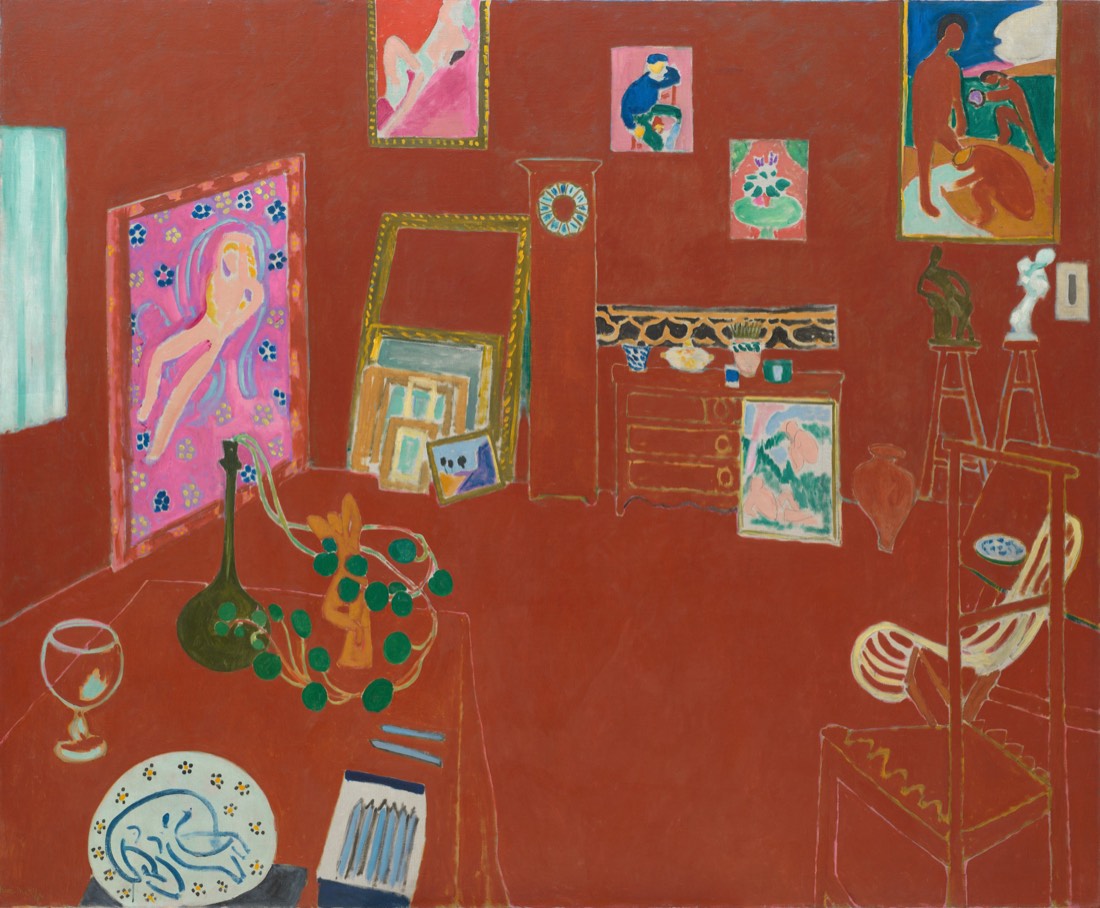
1. The Red Studio: a space repainted in the single colour of memory
Painted in Issy-les-Moulineaux in the fall of 1911, The Red Studio shows Matisse's workspace almost entirely submerged in a uniform red — floor, walls and furniture blurred into a single hue, though the actual room had grey walls. The painting shows six paintings, three sculptures and one ceramic by Matisse himself, arranged as they were in the real studio — as depicted, this is the same grouping of objects Matisse had around him at the time he painted them together.
In 2022, MoMA tracked down and reunited nearly all of these original works for an exhibition devoted to the painting — the first time these objects had been physically together since Matisse's studio, more than a century earlier. Before then, the canvas changes hands several times: bought in 1927 by David Tennant, founder of London's Gargoyle Club, it hangs on that nightclub's walls for nearly fifteen years before being bought by a New York dealer. MoMA acquires it in 1949 — nearly forty years after it was made, and after spending far longer on a nightclub wall than in a museum.
2. Dance: a sketch for Moscow, refused then adored
In early 1909, the Moscow collector Sergei Shchukin, who had followed Matisse's work since meeting him in 1906, commissions two large decorative panels for the staircase of his mansion: one on dance, the other on music. Dance (I), held at MoMA, is the 1909 preparatory sketch for this project — the larger, more vivid final version leaves for Moscow in 1910 and is now held at the Hermitage in Saint Petersburg.
When Shchukin sees the finished version on its arrival in Moscow at the end of 1910, he first cables Matisse to refuse both panels, finding them too bare for his staircase. He changes his mind within days and accepts them after all, later calling them "the most beautiful paintings in my collection." MoMA's sketch, without the revisions and the scenes Matisse would paint with no preparatory drawing at all for the Music panel, still carries the trace of this hesitant beginning.
3. Two goldfish still lifes, two years apart
Goldfish and Sculpture, painted in Issy-les-Moulineaux in spring-summer 1912, is one of four paintings Matisse devoted to goldfish after his first trip to Morocco earlier that year — the fish bowl becomes a motif he returns to across several still lifes and studio views over the following decade.
Goldfish and Palette, painted between late November 1914 and spring 1915, takes up the motif in a composition much closer to Cubism, broken into broad flat bands — a manner of painting Matisse owed in part to his discussions and disagreements with Picasso during the summer of 1914. In the abstract zone on the right of the painting, Matisse himself described "a person who has a palette in his hand and who is observing": most likely the artist, doubled within his own canvas.
4. The Piano Lesson: the son in his father's studio
The Piano Lesson, painted in Issy-les-Moulineaux in late summer 1916, shows Matisse's son Pierre, then sixteen but painted with the features of a much younger boy, seated at the piano. Behind him, the barely sketched silhouette of a woman is not a music teacher but a painting within the painting — Woman on a High Stool, another Matisse canvas hanging in the living room at the time he painted his son. In the foreground at left, a decorative sculpture by Matisse closes the composition: Pierre is literally surrounded by his father's work.
5. The Moroccans: the memory of a journey
The Moroccans, painted in Issy-les-Moulineaux between late 1915 and fall 1916, is a memory of Morocco, which Matisse had visited twice, in 1912 and 1913. The painter himself described the subject as "reclining figures of Moroccans, on a terrace, with their watermelons and gourds"; beyond the yellow and green vegetables, a mosque and a vase of flowers on a balustrade can be made out. Matisse uses black here with unusual generosity, as a colour in its own right that unifies the whole composition rather than a mere shadow.
6. Three more Issy-les-Moulineaux canvases, from window to table
The Blue Window, painted in summer 1913 in the second-floor bedroom of Matisse's house at Issy-les-Moulineaux, is the only painting in which he depicted the exterior of his own studio: through the window, the building appears nestled among trees all rendered in blue, down to its pitched roof and chimney, while the yellow of its façade echoes the objects on the dressing table in the foreground.
Composition, painted at Issy-les-Moulineaux in 1915, shows — according to Matisse's own account in a 1931 interview — the view from a curtained window in his house, including the blue glass canopy over the front door: a domestic subject treated in an almost abstract manner, reduced to broad flat areas of colour.
The Rose Marble Table, painted at Issy-les-Moulineaux in spring-summer 1917, is a still life built around a marble table draped in a pink cloth, topped by a white bowl surrounded by plants; Matisse pushes further the simplified outlines and flat colour of the preceding years, just before his move to Nice, which would mark a turn toward a softer manner.
How much time
The room can be crossed in a few minutes, but the main canvases are worth lingering over; the room's other Matisse paintings round out a decade of experimentation.
- Background on Matisse's studio — 6 minutes.
- The Red Studio — 9 minutes.
- Dance (I) — 7 minutes.
- Goldfish and Sculpture — 5 minutes.
- Goldfish and Palette — 6 minutes.
- The Piano Lesson — 7 minutes.
- The Moroccans — 6 minutes.
- The Blue Window — 6 minutes.
- Composition (1915) — 4 minutes.
- The Rose Marble Table — 4 minutes.
Sources and verification
Checked against MoMA's collection pages (moma.org) and cross-checked with Wikipedia EN/FR.
- MoMA — Henri Matisse, The Red Studio
- Washington Post — Matisse's Red Studio ignites a display at MoMA
- MoMA — Henri Matisse, Dance (I)
- Wikipedia EN — Dance (Matisse)
- Wikipedia EN — Music (Matisse)
- MoMA — Henri Matisse, Goldfish and Sculpture
- MoMA — Henri Matisse, Goldfish and Palette
- MoMA — Henri Matisse, The Piano Lesson
- Wikipedia EN — The Piano Lesson (Matisse)
- MoMA — Henri Matisse, The Moroccans
- MoMA — Gallery 506: Henri Matisse
- MoMA — Henri Matisse, The Blue Window
- MoMA — Henri Matisse, Composition, 1915
- MoMA — Henri Matisse, The Rose Marble Table
Displays and room openings can change. Check the MoMA website on the day of your visit before following a route.
Continue your visit
MoMA, New York
Listen to the commentary in the gallery
This route gives you a thread to follow. In front of an artwork, CulturAll adds the audio commentary: photograph the work or its label, listen, then ask your questions.

