

The Dutch Golden Age in a single gallery
This gallery at the Metropolitan Museum brings together five paintings by Johannes Vermeer — more than any other museum in the world holds — alongside his closest contemporaries in Dutch genre painting: Pieter de Hooch and Gerard ter Borch. By most counts, only about thirty Vermeer paintings have survived the centuries; gathering five of them in a single room is a rarity no other institution can match.
1. The first Vermeer ever to reach America, bought for $800
Young Woman with a Water Pitcher, painted around 1662, was bought in Paris in 1887 by the American collector Henry Gurdon Marquand for around $800 — a modest sum, at a time when Vermeer remained a largely forgotten painter, rediscovered only a few decades earlier by the French critic Théophile Thoré-Bürger. Marquand brought the painting back to the United States: it was the first Vermeer to enter an American public collection, before joining the Metropolitan Museum's holdings with the rest of his bequest.
2. A man at his easel, painted in, then painted out
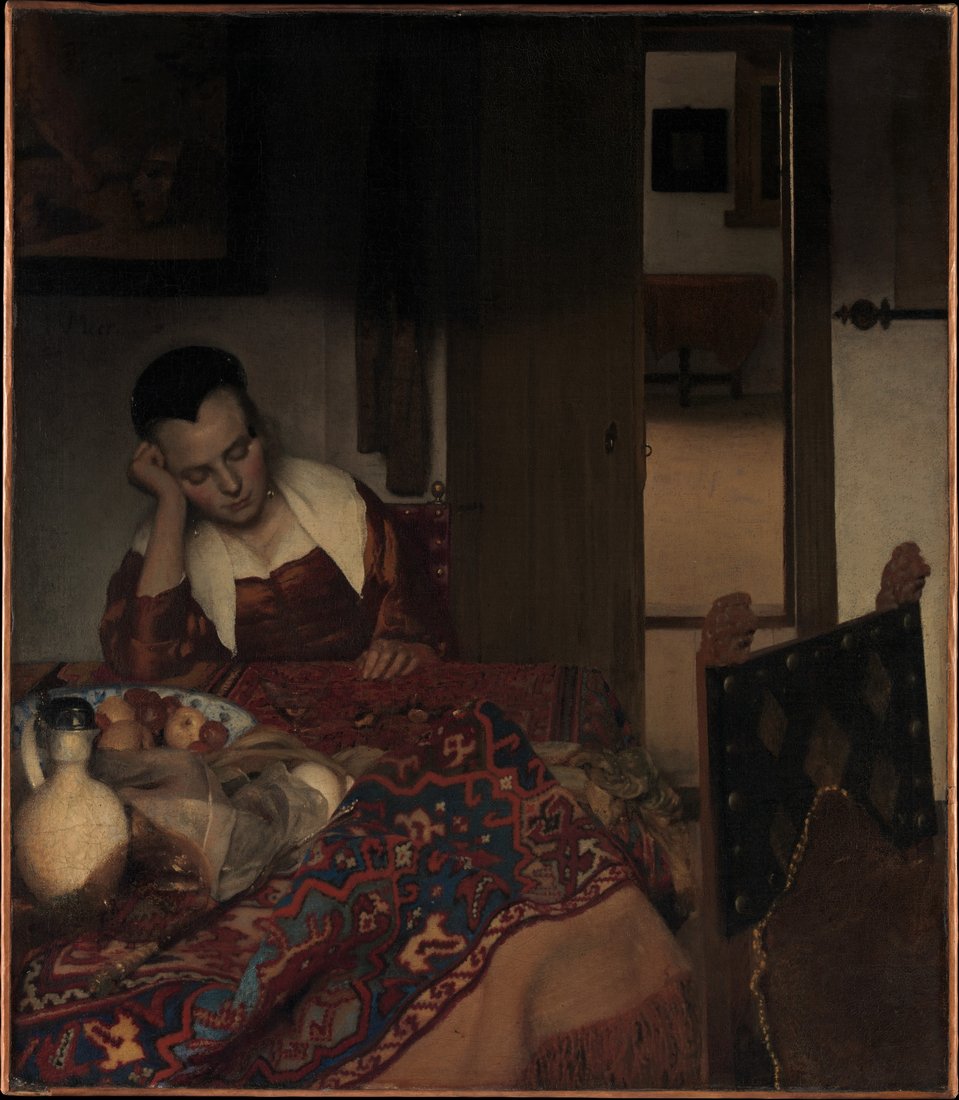
A Maid Asleep, painted around 1656-1657, shows a young woman dozing at a table, in a room opening onto a hallway. In March 2023, researchers from the Metropolitan Museum presented the results of an X-ray fluorescence analysis at a Rijksmuseum symposium: beneath the painting's final layer, in the space of the hallway, there had originally been a man standing at an easel, one arm raised holding a brush — probably Vermeer himself, depicting himself at work, before he painted over the figure entirely.
This change of mind is invisible in any reproduction of the painting as it hangs today: only the X-ray made it possible to reconstruct.
3. Three more Vermeers: a map, a lute, a hidden allegory
Young Woman with a Lute, painted around 1662-1663, shows a woman tuning her instrument by a window, her gaze on the street below — at her feet, a viola da gamba and open songbooks suggest she is preparing for a duet. The map of the Netherlands on the wall reflects a decoration common in Dutch homes of the time, a mark of pride in a nation then at the forefront of navigation and cartography.
Study of a Young Woman, painted around 1665-1667, is not a portrait but a "tronie," a Dutch genre celebrating a face and an expression rather than a precise identity — the composition, with its pearl and draped scarf, closely resembles the famous Girl with a Pearl Earring. The painting belonged to the Wrightsman collection before entering the Metropolitan Museum in 1979, in memory of curator Theodore Rousseau Jr.
Allegory of the Catholic Faith, painted around 1670-1672, personifies the Church as a woman resting her foot on a globe, while the cornerstone of the building crushes a serpent in the foreground. Vermeer, who converted to Catholicism for his marriage, painted this at a time when public celebration of the Catholic Mass was banned in the Protestant Dutch Republic — the glass sphere hanging from the ceiling, reflecting a Crucifixion, evokes the heaven promised to worshippers who continued to celebrate Mass in secret, at home.
4. Pieter de Hooch, the neighbor in the gallery
Paying the Hostess, painted around 1670, shows the hostess of a country inn explaining her account to a fashionably dressed customer, in a courtyard busy with other guests — a "disputed bill" subject rare in Dutch painting, where the overlapping hands of the man and woman suggest flirtation as much as a business transaction.
Interior with a Young Couple, painted around 1662-1665, illustrates Pieter de Hooch's specialty: interiors built from interlocking rectangular spaces, with light falling from one room into the next. Here, a woman looks into a mirror while a seated man plays with their dog — a moment of domestic intimacy in a prosperous household.
5. Gerard ter Borch, an epistolary curiosity
Curiosity, painted by Gerard ter Borch the Younger around 1660-1662, shows women of different ages in a luxurious interior: the eldest writes a letter while the youngest peers over her shoulder, while a third woman, dressed in the radiant satin ter Borch was known for, appears pensive or lovelorn — most likely her older friend is helping her draft a response to a love letter. The painting belongs to the Jules Bache Collection, acquired by the museum in 1949.
How much time
Seven paintings in a single room, plus some of the museum's finest Rembrandts hanging on the same walls — don't limit yourself to Vermeer.
- Young Woman with a Water Pitcher (Vermeer) — 7 minutes.
- A Maid Asleep (Vermeer) — 8 minutes.
- Young Woman with a Lute (Vermeer) — 7 minutes.
- Study of a Young Woman (Vermeer) — 7 minutes.
- Allegory of the Catholic Faith (Vermeer) — 8 minutes.
- Paying the Hostess (de Hooch) — 8 minutes.
- Interior with a Young Couple (de Hooch) — 7 minutes.
- Curiosity (ter Borch) — 8 minutes.
Sources and verification
Checked against the official notices of the Metropolitan Museum of Art (metmuseum.org) and cross-checked with Wikipedia EN/FR.
- The Metropolitan Museum of Art — A New Look at Vermeer
- The Art Newspaper — The Met's Vermeer may contain a hidden self-portrait of the artist at work
- ARTnews — New Research Supports Theory of Hidden Vermeer Self-Portrait
- DailyArt Magazine — Young Woman with a Water Pitcher
- The Met — Young Woman with a Lute (collection record)
- Wikipedia EN — Study of a Young Woman (Vermeer, New York)
- The Met — Allegory of the Catholic Faith (collection record)
- The Met — Paying the Hostess, Pieter de Hooch (collection record)
- The Met — Interior with a Young Couple, Pieter de Hooch (collection record)
- The Met — Curiosity, Gerard ter Borch the Younger
Displays and room openings can change. Check the Metropolitan Museum of Art website on the day of your visit before following a route.
Continue your visit
Metropolitan Museum of Art, New York
Listen to the commentary in the gallery
This route gives you a thread to follow. In front of an artwork, CulturAll adds the audio commentary: photograph the work or its label, listen, then ask your questions.

