

Neoclassicism and Romanticism, the great nineteenth-century quarrel
This room brings together canvases by Eugène Delacroix and Jean-Auguste-Dominique Ingres, the two figures who embody the great aesthetic divide of nineteenth-century French painting: the Neoclassicism inherited from David, which Ingres saw himself as continuing, against the Romanticism of which Delacroix became the leading figure. The rivalry between the two men did not crystallize at the Salons of 1824 or 1827-1828, as is often assumed, but built up more slowly, over the 1830s and 1840s, before reaching its peak at the 1855 Exposition Universelle.
1. Ingres: "a thing well drawn is always a thing well painted"
The portrait of Joseph-Antoine Moltedo, painted around 1810, shows this Corsican-born businessman and director of the Roman post office under Napoleonic administration, set against the Appian Way and the Colosseum — one of the stormy skies and Roman backdrops that mark the series of portraits Ingres painted at the time for French officials in Napoleonic Rome, a deliberate Romantic foil to the calm, assured expression of the sitter. For Ingres, line was painting's supreme virtue, a conviction he summed up in a now-famous phrase — a thing well drawn is always a thing well painted.
In the same room, the Head of Saint John the Evangelist (about 1818-1820) is a painted study for Christ Delivering the Keys to Saint Peter, an altarpiece commissioned in 1817 for the church of Santissima Trinità dei Monti in Rome and completed in 1820 (now in the Musée Ingres, Montauban). Ingres based the composition on Raphael’s tapestry design of the same theme and developed it in eight oil studies — this one among them — and more than seventy drawings; the Met notes that the study may have been reworked in 1841, with touches added as late as 1856.
2. Ingres and the only pair of pendant portraits he ever painted
Jacques-Louis Leblanc and Madame Jacques-Louis Leblanc, painted in 1823 shortly after Ingres met the couple in Florence — she had been lady-in-waiting to Elisa Baciocchi, Napoleon's sister and Grand Duchess of Tuscany; he was her secretary — form the only pair of pendant portraits the painter ever made. Designed to face each other, the two canvases are unified by the echo of hands, gold chains, and rich fabric against black clothing; more than two dozen preparatory drawings survive for Madame Leblanc's portrait alone, held at the Musée Ingres in Montauban.
The painter Edgar Degas first saw the two portraits in 1854 and managed to acquire them in 1896, an event he would describe as "the event of my life as a collector"; the Metropolitan Museum bought them at the sale of his estate in 1918.
3. Delacroix, the abduction of Rebecca from Ivanhoe
The Abduction of Rebecca, painted in 1846 and shown at that year's Salon, illustrates a scene from Sir Walter Scott's novel Ivanhoe, an author Delacroix drew on throughout his career: the Jewish heroine Rebecca, held captive in the burning castle of Front-de-Bœuf, is carried off by two Saracen slaves on the orders of the Christian knight Bois-Guilbert, who covets her. The contorted, interlocking poses and the compressed space, which shifts abruptly from the raised foreground to the fortress behind, create an effect of intense drama that only Rebecca herself, strangely calm, seems to escape.
Long before the Abduction, Delacroix had already drawn on Ivanhoe: Rebecca and the Wounded Ivanhoe (1823, 64.5 × 53.7 cm) was his first attempt at a subject taken from Walter Scott, whom French Romantics then admired as much as Byron and Shakespeare. The painting shows a wounded Ivanhoe straining to get out of his sickbed while Rebecca describes the raging battle outside (chapter 29); both are imprisoned in the castle of Torquilstone. The Met acquired the painting in 2019.
4. Delacroix, a family fleeing a massacre on the Mississippi
The Natchez, begun in 1823 and completed in 1835, draws on a passage from Chateaubriand's novel Atala: fleeing the massacre of their tribe by French forces, a Native American couple travels up the Mississippi when the woman goes into labor. In the catalogue for the 1835 Salon, Delacroix himself described the moment depicted: the father holding the newborn in his hands, both of them gazing at the child tenderly — a canoe and two paddles on the riverbank, a decorated pot, and a tomahawk planted in the earth complete the scene.
5. Delacroix, Ovid in exile among the Scythians
Ovid among the Scythians, painted in 1862, revisits a subject Delacroix had returned to since 1835: the Latin poet Ovid, banished from Rome in the year 8 to the shores of the Black Sea, is welcomed with kindness by the Scythians, who offer him mare's milk to drink. This version reprises a larger composition shown at the 1859 Salon — now in the National Gallery, London — of which the critic Charles Baudelaire wrote that "the mind sinks into it with a slow and appreciative rapture."
6. Delacroix, faith tested on a raging sea
Christ Asleep during the Tempest, painted around 1853, revisits a gospel episode to which Delacroix devoted at least six versions over the course of his career: woken by his disciples, terrified by the storm, Christ rebukes them for their lack of trust in Providence before calming the waves. In this later version, the boat occupies a larger place than in earlier versions, hemmed in by a teal sea lit with pale, churning froth.
In 1886, Vincent van Gogh saw this painting in Paris and praised it in a letter: he described "Christ's boat" painted in blue and green, with touches of purple, red and a little lemon yellow for the halo — a symbolic language carried by colour alone rather than by the subject, a lesson Van Gogh would take into his own painting.
7. Delacroix, a basket of flowers painted at Champrosay
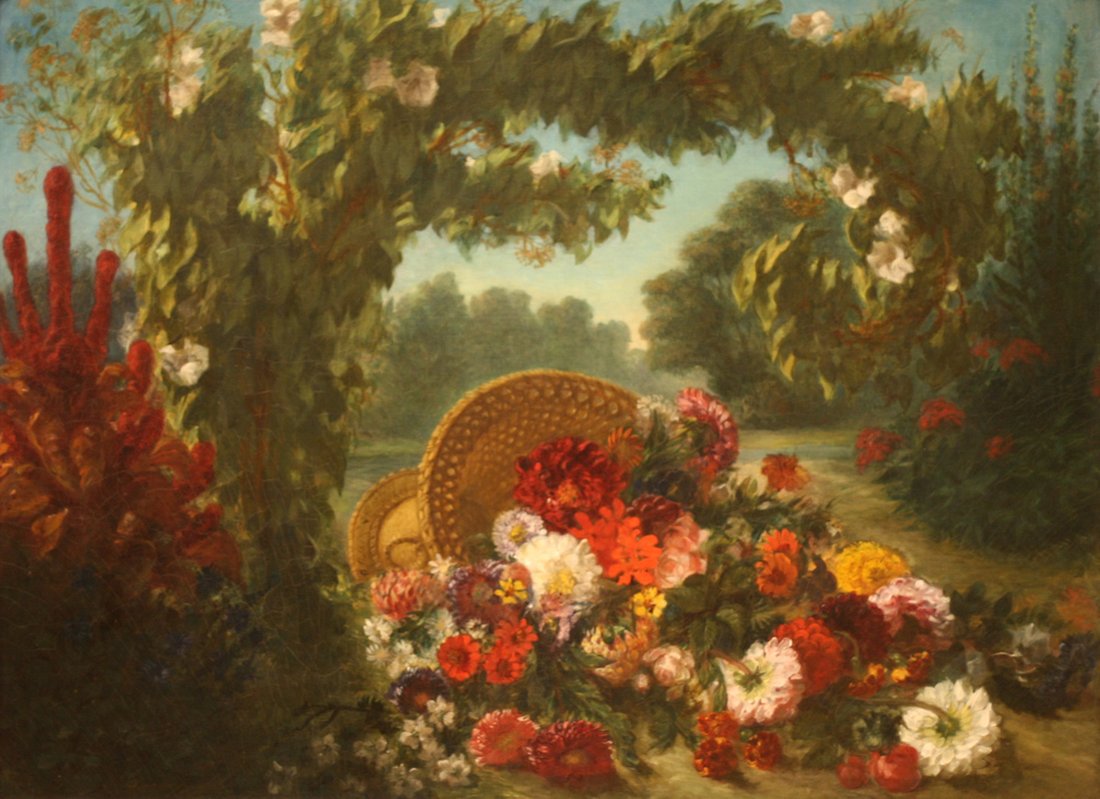
Basket of Flowers (1848-1849, 107.3 × 142.2 cm): in September 1848 Delacroix withdrew to his country house at Champrosay and began a series of flower paintings intended for the Salon of 1849. Threatened by early frost, he worked quickly and produced five canvases; only two satisfied him enough to be shown at the Salon: this one and Basket of Flowers and Fruit at the Philadelphia Museum of Art. A subject far removed from the literary and historical scenes shown elsewhere in the room.
How much time
Move from one wall to the other comparing the brushwork directly: Ingres's crisp contour against Delacroix's colored glazes.
- Background on the Ingres-Delacroix rivalry — 6 minutes.
- Joseph-Antoine Moltedo (Ingres) — 6 minutes.
- Jacques-Louis Leblanc (Ingres) — 5 minutes.
- Madame Leblanc (Ingres) — 6 minutes.
- The Abduction of Rebecca (Delacroix) — 7 minutes.
- The Natchez (Delacroix) — 6 minutes.
- Ovid among the Scythians (Delacroix) — 7 minutes.
- Christ Asleep during the Tempest (Delacroix) — 6 minutes.
- Head of Saint John the Evangelist (Ingres) — 5 minutes.
- Rebecca and the Wounded Ivanhoe (Delacroix) — 6 minutes.
- Basket of Flowers (Delacroix) — 6 minutes.
Sources and verification
Checked against the official notices of the Metropolitan Museum of Art (metmuseum.org) and cross-checked with Wikipedia EN/FR.
- Oxford Academic — Ingres versus Delacroix (Art History)
- JSTOR Daily — Ingres vs Delacroix: An Artistic Rivalry Spills Over at a Party
- The Art Story — Eugène Delacroix
- The Art Story — Jean-Auguste-Dominique Ingres
- The Met — Joseph-Antoine Moltedo (collection record)
- The Met — Jacques-Louis Leblanc (collection record)
- The Met — Madame Jacques-Louis Leblanc (collection record)
- The Met — The Abduction of Rebecca (collection record)
- The Met — The Natchez (collection record)
- The Met — Ovid among the Scythians (collection record)
- The Met — Christ Asleep during the Tempest (collection record)
- Wikipedia EN — Christ Asleep during the Tempest
- The Met — Head of Saint John the Evangelist (collection record)
- The Met — Rebecca and the Wounded Ivanhoe (collection record)
- The Met — Basket of Flowers (collection record)
Displays and room openings can change. Check the Metropolitan Museum of Art website on the day of your visit before following a route.
Continue your visit
Metropolitan Museum of Art, New York
Listen to the commentary in the gallery
This route gives you a thread to follow. In front of an artwork, CulturAll adds the audio commentary: photograph the work or its label, listen, then ask your questions.

