

Flemish Baroque and French Classicism, side by side
This room brings together Flemish Baroque paintings and French Classical canvases of the seventeenth century, including major works by Peter Paul Rubens, Nicolas Poussin, Jacob Jordaens, and Claude Lorrain — two competing styles in Catholic Europe of the period, one favoring movement and color, the other composition and balance.
1. The finished painting burned, only the sketch survived
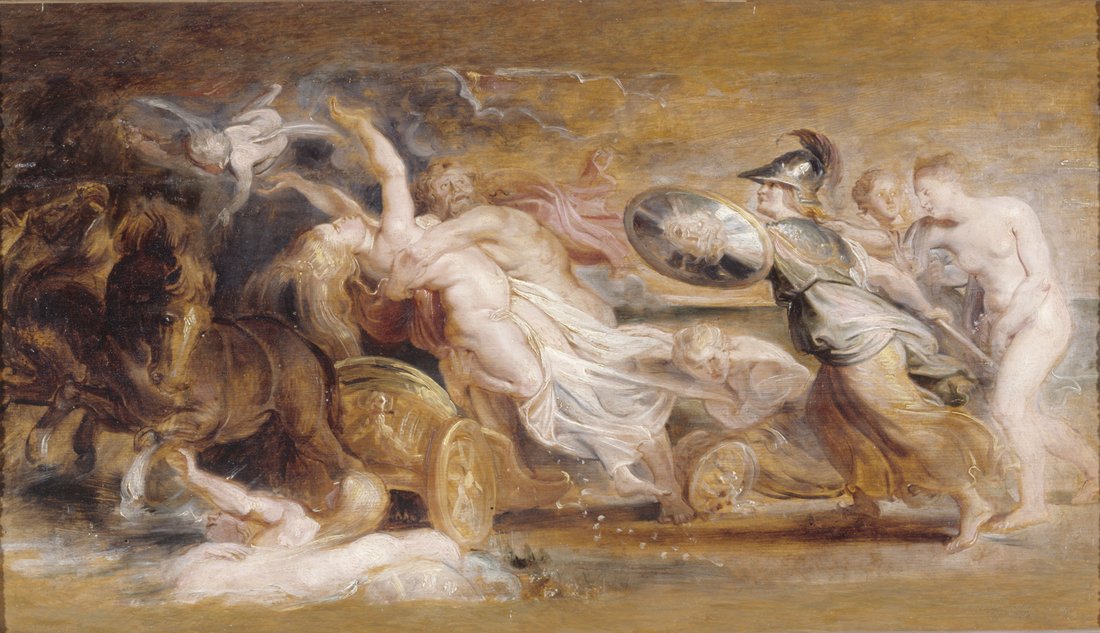
The Abduction of Proserpina, painted by Rubens around 1614-1615, is not the finished painting commissioned from the artist at the time, but his preparatory sketch. The finished version, which entered the collection of the Duke of Marlborough at Blenheim Palace, was destroyed by fire in 1861 — making this sketch, held at the Petit Palais, the only surviving visual record of Rubens's original composition.
2. A Poussin whose authenticity long divided specialists
The Massacre of the Innocents, painted around 1625-1627, had its attribution to Poussin contested for a long time by recognized specialists of the painter, including Anthony Blunt and Jacques Thuillier, who refused to see his hand in it. The painting is now largely accepted as an authentic work by Poussin — a distinct, earlier version from a second, later version of the same subject now held at the Musée Condé in Chantilly, commissioned by a different Roman collector.
3. Jordaens, two faces of Antwerp Baroque
The Rest of Diana, painted between 1640 and 1650, turns the mythological scene into an allegory of earthly abundance: rather than following traditional Ovidian iconography, Jordaens makes it a celebration of flesh and fertility, surrounding a resting Diana with satyrs, bacchantes, and hunting trophies. A twin version exists at the Louvre; the painting later inspired Cézanne's own bather compositions.
The Martyrdom of Saint Apollonia, painted after 1628, shows the saint kneeling while a muscular executioner tears out her teeth with pincers, watched by a plumed, turbaned horseman and eight cherubs in the sky. This grisaille on paper is most likely the preparatory model for an engraving made in 1629, for an altarpiece commissioned for an Augustinian church in Antwerp, where it hung alongside works by Rubens and Van Dyck.
4. Claude Lorrain, a landscape painted for a pope
Landscape with the Port of Santa Marinella, painted around 1639 on copper, shows an idealized view of a small port near Civitavecchia, commissioned by Pope Urban VIII. Rather than a precise topographical view, Claude Lorrain builds the whole composition around a golden sunrise — the gesture of one of the horsemen in the foreground points more clearly to the rising sun than to the port itself.
5. Dorigny, a cycle of Diana broken up in the nineteenth century
Diana and Actaeon, painted between 1635 and 1640 by Michel Dorigny — pupil and son-in-law of Simon Vouet —, shows Diana and her nymphs, nude, around a pool in a rocky landscape; the goddess, wearing a crescent-moon diadem and leaning on a spear, is shielded from Actaeon's gaze by two companions holding up a cloth, while the hunter, already sprouting stag antlers as punishment for having seen the goddess naked, flees to the right.
Diana Discovering Callisto's Pregnancy, painted by Dorigny in the same years, shows Diana, surrounded by her nymphs, watching two attendants examine Callisto beside a fountain adorned with a putto. These two oval canvases of matching size were part of a decorative ensemble of five panels on the myth of Diana, whose other three — now in private collections — decorated a nineteenth-century Parisian townhouse before the cycle was broken up.
How much time
Two paintings, two stories of doubt: one about what the finished work really looked like, the other about who really painted it.
- Background on the room — 6 minutes.
- The Abduction of Proserpina (Rubens) — 9 minutes.
- The Massacre of the Innocents (Poussin) — 9 minutes.
- The Rest of Diana (Jordaens) — 7 minutes.
- The Martyrdom of Saint Apollonia (Jordaens) — 7 minutes.
- Landscape with the Port of Santa Marinella (Claude Lorrain) — 8 minutes.
- Diana and Actaeon (Dorigny) — 7 minutes.
- Diana Discovering Callisto's Pregnancy (Dorigny) — 7 minutes.
Sources and verification
Checked against the official notices of the Petit Palais (petitpalais.paris.fr / parismuseescollections.paris.fr) and cross-checked with Wikipedia EN/FR.
- Petit Palais — Pierre Paul Rubens, L'Enlèvement de Proserpine, entre 1614 et 1615
- Paris Musées Collections — L'Enlèvement de Proserpine
- Petit Palais — Nicolas Poussin, Le Massacre des Innocents, vers 1626-1627
- Wikipédia FR — Le Massacre des Innocents (Poussin)
- Paris Musées — Le Repos de Diane, Jordaens
- Paris Musées — Le Martyre de Sainte Apolline, Jordaens
- Paris Musées — Paysage avec le port de Santa Marinella, Claude Lorrain
- Paris Musées — Michel Dorigny, Diane et Actéon, entre 1635 et 1640
- Paris Musées — Michel Dorigny, Diane découvrant la grossesse de Callisto
Displays and room openings can change. Check the Petit Palais website on the day of your visit before following a route.
Continue your visit
Petit Palais, Paris
Listen to the commentary in the gallery
This route gives you a thread to follow. In front of an artwork, CulturAll adds the audio commentary: photograph the work or its label, listen, then ask your questions.

