

An entire room devoted to Gustave Courbet
This room brings together around a dozen paintings by Gustave Courbet, from youthful portraits painted at Ornans to the bolder scenes of his mature Paris years — a large enough group to trace, within a single room, the evolution of a painter who built his career in constant opposition to the official art of his time.
1. A young man and his dog, the only painting accepted out of three
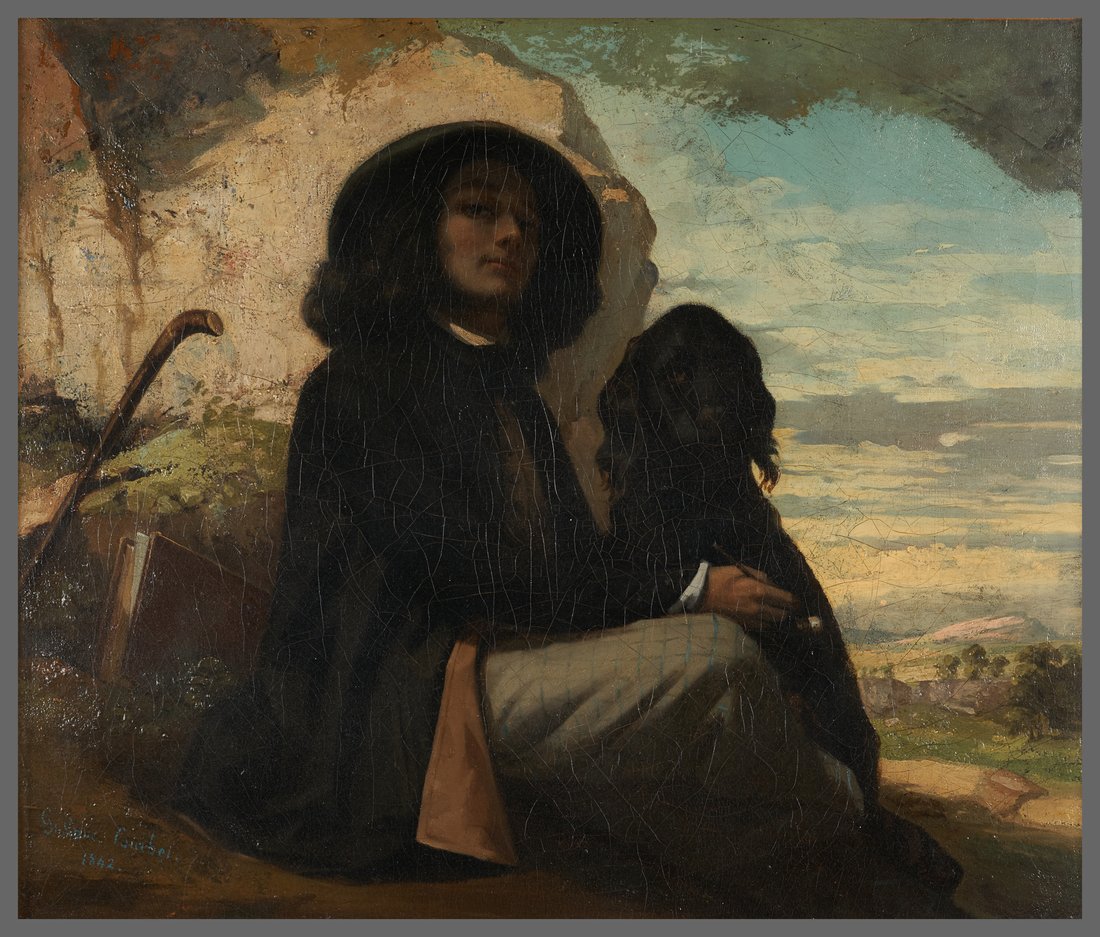
The Self-Portrait with a Black Dog, painted in 1842 and reworked in 1844, is one of Courbet's very first paintings accepted at the official Paris Salon, which opened in March 1844 at the Louvre — of three canvases submitted by the young, then almost unknown painter, only this one was selected by the jury, under the neutral title Portrait of the Author. Courbet shows himself seated in the grass, a black dog beside him, in a pose already marked by the self-assurance that would define his entire career.
From the same period comes the Portrait of Zélie Courbet, painted around 1842: the painter's youngest sister, a bindweed flower in her braided hair, is shown with a naturalness still far removed from the large, scandalous compositions that would follow.
2. Young Ladies Beside the Seine, the Salon's first scandal
Young Ladies Beside the Seine (Summer), painted in 1856-1857 and shown at the 1857 Salon, shows two Parisian women cooling off by the water, stretched out in a languid pose whose blunt naturalism scandalized contemporaries — six years before Manet caused a comparable uproar with Le Déjeuner sur l'herbe. Begun at Ornans in 1856, the painting was finished in the studio: a largely imagined composition rather than a scene captured from life.
3. Proudhon and His Children, a tribute painted after the fact
Pierre-Joseph Proudhon and His Children in 1853, painted in 1865, shows the anarchist philosopher seated on the steps of his house on the rue d'Enfer in Paris, in a work blouse, surrounded by books and papers, while his two daughters Catherine and Marcelle play beside him. Courbet painted this in the very year of Proudhon's death, as a tribute to a close friend — Marcelle herself had already died in 1854, eleven years before the painting was completed.
4. Siesta During Haying Season, the first Courbet to enter Paris's collections
Siesta During Haying Season (Mountains of the Doubs), painted in 1867, shows a peasant woman and two young men asleep in the grass, in the shade of an archway of trees, near two pairs of harnessed oxen. Before showing it at the 1869 Salon, Courbet removed a hay maker who had originally stood at the center of the composition. Bought in Paris at an auction held after the painter's death, in 1881, this was the very first Courbet painting to enter the City of Paris's collections.
5. Le Sommeil, a painting banned from public display for over a century
Le Sommeil (The Sleepers), painted in 1866, shows two nude women asleep, entwined in a rumpled bed — a broken pearl necklace and a hairpin, left on the sheet, leave little doubt about the scene's nature. The painting was commissioned by the Ottoman diplomat Halil Şerif Pasha, known as Khalil Bey, a Paris-based collector who also owned Courbet's other scandalous painting, The Origin of the World.
When a dealer tried to exhibit it in 1872, Le Sommeil became the subject of a police report for indecency. The painting was not permitted to be shown publicly again until 1988 — more than a century after it was painted.
6. A painting stolen during the Commune, another left unfinished
Three Bathers, painted around 1865-1869, shows three nude women by the water in a wooded corner of Franche-Comté: a dark-haired bather climbs down a rock toward the water, steadied by a second bather in a red skirt and white chemise, while a third, blonde, sits with her feet in the water. The painting was stolen from Courbet's studio while he was imprisoned following the Paris Commune, then recovered from a dealer in 1874 by Étienne Baudry and Jules Castagnary — Courbet then enlarged the canvas and added the bather seen from behind.
Firemen Running to a Fire, painted in 1850-1851, is a monumental canvas over five metres wide: a nighttime Paris street scene in which firemen race with their pump through a crowd, watched with indifference by a bourgeois couple, while a working-class woman with an infant calls out and a fallen worker lies in the foreground. Courbet had the firemen of the Poissy fire station stage a torchlit nighttime departure so he could paint it from life; the 1851 coup d'état halted the project, and the unfinished canvas was found rolled up in the painter's studio after his death.
How much time
Compare the confident pose of the 1844 young Courbet to the unabashed boldness of the mature Courbet: it's the same self-assurance, applied to very different registers.
- Background on the Courbet room — 6 minutes.
- Self-Portrait with a Black Dog — 7 minutes.
- Portrait of Zélie Courbet — 5 minutes.
- Young Ladies Beside the Seine — 7 minutes.
- Proudhon and His Children — 6 minutes.
- Siesta During Haying Season — 6 minutes.
- Le Sommeil — 9 minutes.
- Three Bathers — 7 minutes.
- Firemen Running to a Fire — 7 minutes.
Sources and verification
Checked against the official notices of the Petit Palais (petitpalais.paris.fr / parismuseescollections.paris.fr) and cross-checked with Wikipedia EN/FR.
- Petit Palais — Courbet with a black dog
- Wikipédia FR — Autoportrait au chien noir
- Wikipedia EN — Le Sommeil
- The Daily Beast — The Muslim Playboy Behind Paris' Most Scandalous Painting
- Paris Musées — Portrait de Zélie Courbet
- Paris Musées — Les demoiselles des bords de la Seine (été)
- Paris Musées — Pierre-Joseph Proudhon et ses enfants en 1853
- Paris Musées — La sieste pendant la saison des foins
- Paris Musées — Trois baigneuses
- Paris Musées — Pompiers courant à un incendie
Displays and room openings can change. Check the Petit Palais website on the day of your visit before following a route.
Continue your visit
Petit Palais, Paris
Listen to the commentary in the gallery
This route gives you a thread to follow. In front of an artwork, CulturAll adds the audio commentary: photograph the work or its label, listen, then ask your questions.

