

The Bridgewater Collection, on loan to Edinburgh since 1945
The 5th Earl of Ellesmere, later 6th Duke of Sutherland, placed part of the Bridgewater Collection on loan to the Scottish National Gallery in 1945 — one of the most important private collections of Old Master paintings ever assembled in the UK. Two Titians rank among its centerpieces, alongside a Raphael, a Rembrandt, and several Poussins — a group that has remained on continuous view in Edinburgh ever since.
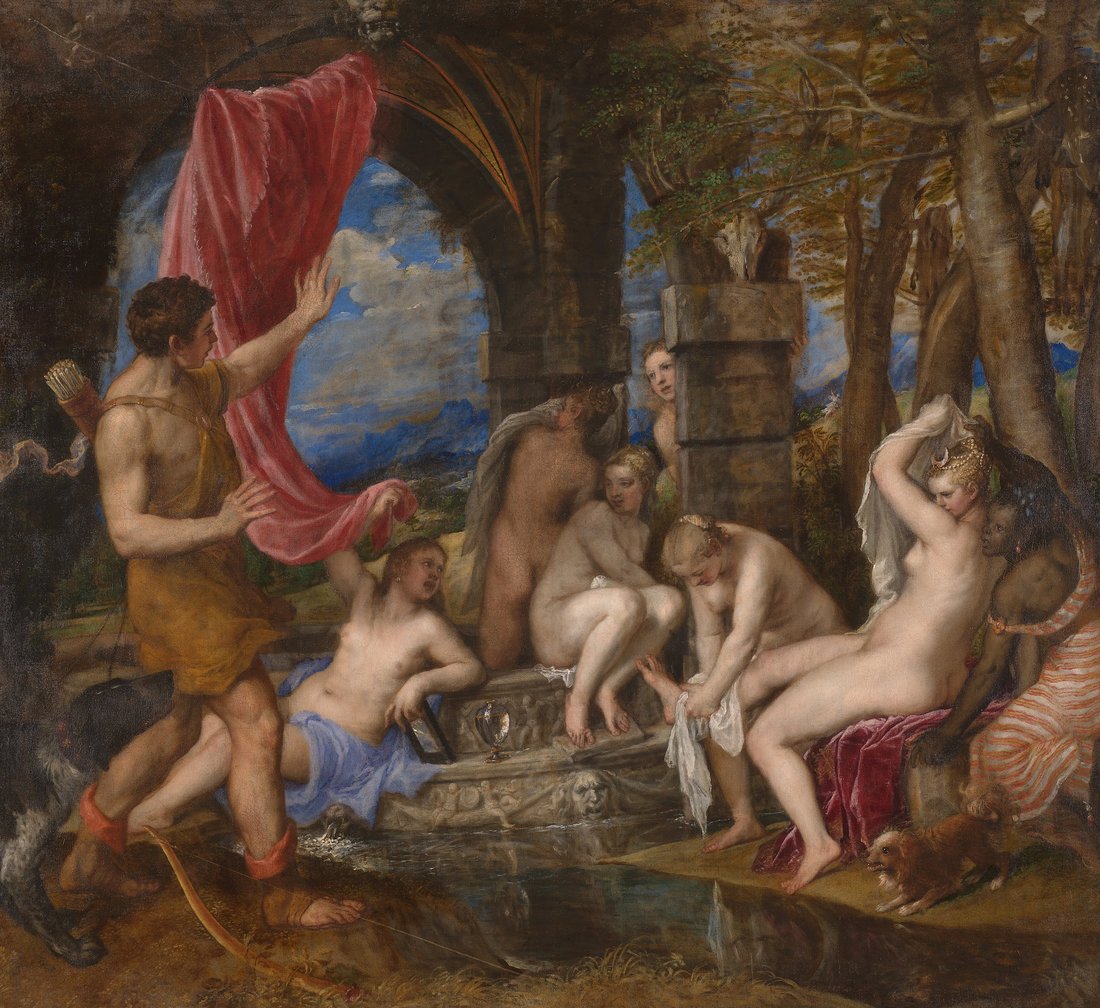
1. Diana and Actaeon, bought for £50 million in 2009
Diana and Actaeon, painted between 1556 and 1559, shows the hunter Actaeon accidentally stumbling upon the goddess Diana and her nymphs bathing — the moment just before his punitive transformation into a stag, then torn apart by his own hounds. The painting belonged to the Duke of Sutherland's collection, on long-term loan to the two national galleries. When the family decided to sell, a public campaign raised £50 million in 2009 to buy it jointly, keeping it from leaving the country.
2. Diana and Callisto, the pair bought three years later
Diana and Callisto, painted in the same period, shows the nymph Callisto exposed by Diana in front of the other nymphs, her hidden pregnancy revealed. To keep the two paintings, conceived as a pair, together, the Duke of Sutherland's family agreed in 2012 to lower the asking price to £45 million, allowing for a second public campaign. Since then the two canvases have alternated every five years between Edinburgh and London; for the 2026-2030 rotation, both are on view at the Scottish National Gallery. Buying the two Titians also secured a further twenty-one years of display in Edinburgh for the rest of the Bridgewater Collection.
3. Raphael, the Madonna whose background was painted over
The Virgin and Child, known as the "Bridgewater Madonna," painted around 1507-1508, shows the Virgin and Child in an elegant twisting pose, their glances meeting — a composition that owes much to what Raphael was then observing of Leonardo da Vinci's work in Florence. Technical analysis has revealed that Raphael originally painted a landscape background before covering it with a dark one, likely to better set off the modeling of the figures through light and shadow.
4. Rembrandt, a self-portrait at 51, darkened by grief
Self-Portrait, Aged 51, painted around 1657, shows the painter's direct, almost insistent gaze, in a dark, unsparing treatment of the textures of aging skin. Rembrandt painted this self-portrait after enduring heavy personal and financial hardship — the deaths of his wife Saskia and three of their infant children, followed by mounting money troubles — and the minimal space left between his gaze and the edge of the frame gives the painting an immediate physical presence.
5. Poussin, the Eucharist and Penance from the Seven Sacraments series
The Sacrament of the Holy Eucharist, painted by Nicolas Poussin in 1647, depicts the Last Supper: rather than the single long table of traditional depictions, Poussin groups the apostles around ancient-style reclining couches, a deliberate archaeological reconstruction of the sacrament's origins — the figure of Judas, isolated in shadow, exits the scene to the left.
The Sacrament of Penance, painted the same year, belongs to the same Seven Sacraments series, the second cycle Poussin painted on this theme after an earlier series now dispersed — seven paintings in total, several of which remain on view together at the Scottish National Gallery.
6. Poussin, Baptism, set among ruins
The Sacrament of Baptism, painted by Poussin in 1646, shows Saint John baptising Christ on the banks of the River Jordan. Ruins in the landscape evoke the antique world and give the scene an authentic setting; in keeping with convention, all the action centres on Christ and Saint John, with the dove of the Holy Spirit hovering above them, to the astonishment of three men at the far right. The canvas, about 117 × 177 cm, belongs to the same Seven Sacraments series as the Eucharist and Penance.
7. Poussin, Extreme Unction, a dying Roman soldier
The Sacrament of Extreme Unction, painted in 1644, is one of the first paintings completed in this second series. Poussin shows a dying Roman soldier who is a Christian, anointed with holy oil by a priest. The group of figures, strongly horizontal in emphasis, resembles a classical relief sculpture, while the room's central perspective gives it a stage-like setting.
How much time
Two paintings conceived as a single composition: compare the light and composition of one against the other before moving on to the rest of the Bridgewater Collection.
- Background on the Bridgewater Collection — 6 minutes.
- Diana and Actaeon (Titian) — 9 minutes.
- Diana and Callisto (Titian) — 9 minutes.
- Bridgewater Madonna (Raphael) — 6 minutes.
- Self-Portrait, Aged 51 (Rembrandt) — 7 minutes.
- Sacrament of the Holy Eucharist (Poussin) — 6 minutes.
- Sacrament of Penance (Poussin) — 5 minutes.
- Sacrament of Baptism (Poussin) — 6 minutes.
- Sacrament of Extreme Unction (Poussin) — 6 minutes.
Sources and verification
Checked against the official notices of the National Gallery, London and the National Galleries of Scotland (nationalgalleries.org) and cross-checked with Wikipedia EN/FR.
- National Gallery, London — 'Diana and Actaeon' is Secured for the Nation
- National Gallery, London — 'Diana and Callisto' secured for the public
- National Galleries of Scotland — Diana and Actaeon, Titian
- National Galleries of Scotland — Diana and Callisto, Titian
- CODART — Titian acquisition secures Bridgewater Loan for Scottish National Gallery
- National Galleries of Scotland — The Virgin and Child ('The Bridgewater Madonna'), Raphael
- National Galleries of Scotland — Self-portrait, aged 51, Rembrandt
- National Galleries of Scotland — The Sacrament of the Holy Eucharist, Poussin
- National Galleries of Scotland — The Sacrament of Penance, Poussin
- National Galleries of Scotland — The Sacrament of Baptism, Poussin
- National Galleries of Scotland — The Sacrament of Extreme Unction, Poussin
Displays and room openings can change. Check the Scottish National Gallery website on the day of your visit before following a route.
Listen to the commentary in the gallery
This route gives you a thread to follow. In front of an artwork, CulturAll adds the audio commentary: photograph the work or its label, listen, then ask your questions.

