

A room for the generation that invented the Florentine portrait
This gallery brings together portraits painted in Florence between roughly 1450 and 1500: Andrea del Castagno, Botticelli, Filippino Lippi and Perugino all show young Florentines in profile or three-quarter view, from a generation that turned the portrait into a genre in its own right rather than a mere accessory to a religious altarpiece. Perugino's portrait of Lorenzo di Credi even shows one painter depicting another, a sign of the close ties between the city's workshops.
1. A portrait, a juniper, and a pun
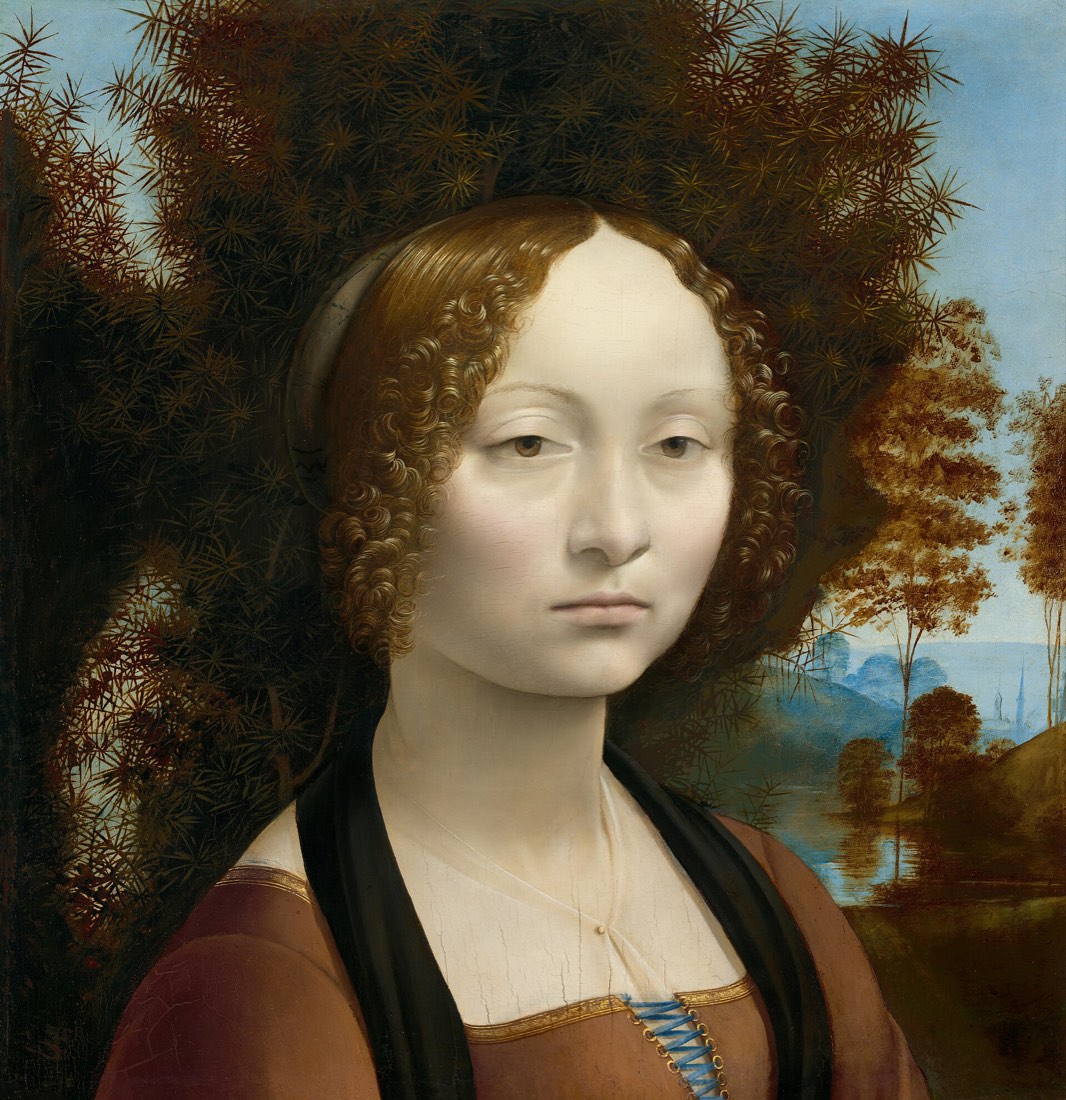
Ginevra de' Benci, painted by Leonardo da Vinci around 1474-1478, shows a young Florentine woman known for her beauty and her poetic intelligence, framed by the spiky leaves of a juniper bush. The choice is not decorative: in Italian, juniper is ginepro, a direct pun on the young woman's name. The panel has been cut down by about a third at the bottom, probably following early damage: Ginevra's hands, now lost, survive only in a preparatory drawing held at Windsor Castle.
On the reverse of the panel, a wreath of laurel and palm encircles the same juniper sprig, alongside the Latin motto "Virtutem Forma Decorat" — beauty adorns virtue.
2. A hidden motto, revealed by infrared
In 1991, an infrared examination revealed that a different inscription originally lay beneath the wreath on the reverse: "Virtus et Honor," the personal motto of Bernardo Bembo, Venetian ambassador to Florence in the 1470s. Poems exchanged at the time between Bembo and Ginevra point to a platonic relationship, in the tradition of courtly love, and suggest that it may have been Bembo who commissioned this portrait — before a repainting replaced his personal motto with the more neutral one visible today.
This change of patron, or of intended recipient, remains debated among art historians, but the discovery confirms that this small panel carries a more complicated history than Ginevra's serene face suggests.
3. A painting shipped in a suitcase
The National Gallery of Art bought the painting in 1967 from Prince Franz Joseph II of Liechtenstein for around $5 million — a world record price for a work of art at the time. Sensitive to humidity and temperature swings, the panel was fixed inside a waterproof American Tourister suitcase lined with foam and fitted with a thermometer and a hygrometer, itself wrapped in plastic inside a wooden crate for transport.
4. Castagno, before Leonardo
Andrea del Castagno's Portrait of a Man, painted around 1450-1457, predates Ginevra by more than twenty years: against a delicately graduated blue background, a man gazes straight at the viewer in three-quarter bust view, a deep black collar cutting sharply against a full crimson cloak. The painting has had an unexpected second life: reproduced on the Italian 10,000-lira banknote in circulation between 1976 and 1984, it is one of the few National Gallery works to have passed from hand to hand in an entire country's wallets.
5. Botticelli, Filippino Lippi and Perugino, the Florentine workshop in full
The Portrait of a Young Man attributed to Botticelli, painted around 1482-1485, shows an unidentified sitter with a pensive gaze and an elegantly posed hand — a hand whose position has led some medical historians to speculate about possible juvenile arthritis or Marfan syndrome, though none of these theories has reached consensus.
Filippino Lippi's Portrait of a Youth, painted around 1485, is so close to Botticelli's style — Filippino became his pupil after his own father Filippo Lippi died in 1469 — that its attribution was long disputed between the two painters; most specialists now credit it to the pupil rather than the master. The face strongly recalls a young man Filippino painted in the Brancacci Chapel in Florence, whose frescoes he finished in 1483-1484 after Masaccio.
Perugino's Portrait of Lorenzo di Credi, painted in 1488, shows one painter depicting another: Lorenzo di Credi was Perugino's fellow apprentice in Verrocchio's workshop, alongside the young Leonardo da Vinci himself. This painting's presence in the same room as Ginevra de' Benci closes the loop: the three men who learned their craft together end up, decades later, reunited on the walls of Washington.
6. Two child busts and a youth sold as a Pinturicchio
The gallery’s two marble busts shared the same place for more than two centuries. Antonio Rossellino’s Young Saint John the Baptist (about 1470, 34.7 × 29.8 × 16.1 cm) shows the head and shoulders of a young boy with short curly hair, an animal skin over one shoulder; Saint John the Baptist is one of Florence’s patron saints. Desiderio da Settignano’s Christ Child (?) (about 1460, 30.5 × 26.5 × 16.3 cm) answers it: as early as 1756 both busts stood in the oratory of San Francesco dei Vanchettoni in Florence, each in a niche above a side door of the high altar, and Florentine guidebooks attributed them to Donatello. Sold in 1940, they were bought in 1942 by the Samuel H. Kress Foundation, which gave them to the National Gallery in 1943.
The Portrait of a Youth, attributed to Agnolo or Donnino di Domenico del Mazziere and dated about 1495-1500, is an oil on panel transferred to canvas (51.5 × 34 cm). It came up for sale in Amsterdam in 1923 under the name of Pinturicchio, then passed through Duveen; the Kress Foundation bought it in 1938 and gave it to the National Gallery in 1939.
How much time
Look for the juniper sprig on both sides of Leonardo's panel — front and back answer each other, and that is where Bernardo Bembo's story hides. Allow a little over an hour for the gallery's featured works; about twenty minutes is enough for Ginevra alone, front and back.
- Background on the Florentine portrait gallery — 5 minutes.
- Ginevra de' Benci, obverse (Leonardo da Vinci) — 8 minutes.
- Bembo's motto, reverse (Leonardo da Vinci) — 6 minutes.
- The 1967 purchase and transport — 5 minutes.
- Portrait of a Man (Andrea del Castagno) — 6 minutes.
- Portrait of a Young Man (Botticelli) — 6 minutes.
- Portrait of a Youth (Filippino Lippi) — 5 minutes.
- Portrait of Lorenzo di Credi (Perugino) — 6 minutes.
- Bust of the Young Saint John the Baptist (Rossellino) — 6 minutes.
- The Christ Child (?) (Desiderio da Settignano) — 5 minutes.
- Portrait of a Youth (Mazziere) — 6 minutes.
Sources and verification
Checked against the official notices of the National Gallery of Art (nga.gov) and cross-checked with Wikipedia EN/FR.
- National Gallery of Art — Ginevra de' Benci [obverse], Leonardo da Vinci
- National Gallery of Art — 10 Surprising Facts About Ginevra de' Benci
- Smithsonian Magazine — Meet Ginevra de' Benci
- Wikipedia EN — Ginevra de' Benci
- Wikipedia EN — Portrait of a Man (Castagno)
- Wikipedia EN — Portrait of a Young Man (Botticelli, Washington)
- National Gallery of Art — Portrait of a Youth, Filippino Lippi
- Wikipedia EN — Portrait of Lorenzo di Credi (Perugino)
- National Gallery of Art — The Young Saint John the Baptist, Antonio Rossellino
- National Gallery of Art — The Christ Child (?), Desiderio da Settignano
- National Gallery of Art — Portrait of a Youth, Agnolo or Donnino di Domenico del Mazziere
Displays and room openings can change. Check the National Gallery of Art website on the day of your visit before following a route.
Continue your visit
National Gallery of Art, Washington
Listen to the commentary in the gallery
This route gives you a thread to follow. In front of an artwork, CulturAll adds the audio commentary: photograph the work or its label, listen, then ask your questions.

