

A room with no unity of place or period
Nothing at first sight connects a Raphael panel painted in Perugia around 1502 with a Tiepolo canvas painted in Venice two centuries later: not the workshop, not the generation, not even the format. This room embraces that gap rather than hiding it, bringing together examples of Italian painting from the early sixteenth to the early eighteenth century — from the Florentine and Roman High Renaissance through to late Venetian Baroque.
The connecting thread is therefore not stylistic: it is that of an early nineteenth-century English private collection, capable of bringing together pieces from every Italian school without confining itself to a single period — the kind of selection no museum would put together the same way today.
1. Two fragments of a dispersed altarpiece
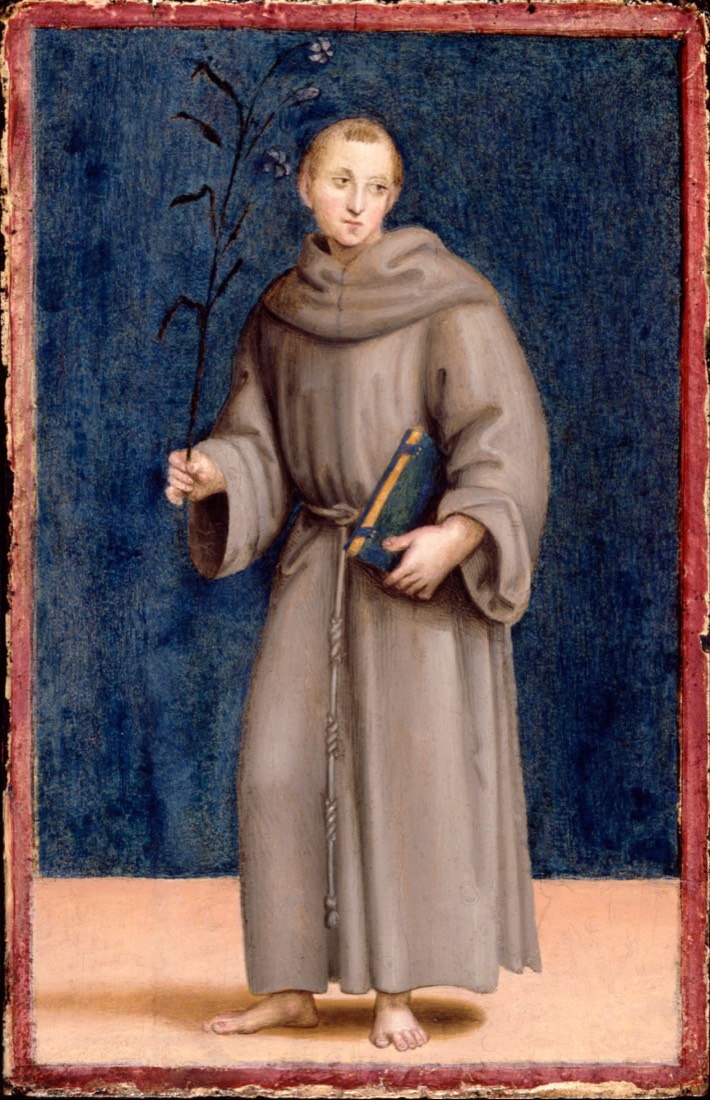
Saint Francis of Assisi and Saint Anthony of Padua, two small oil panels each measuring 25.6 by 16.4 centimetres, were painted by Raphael around 1502, while he was still working in Perugia within Perugino's orbit. They originally formed the two outer ends of the predella of the Colonna Altarpiece, a major commission painted for the Poor Clares of the church of Saint Anthony of Padua in Perugia — one of the rare early Raphael ensembles whose original destination is known with precision.
The altarpiece was dismembered, like so many others, after leaving the church for the art market: the central panel, along with one predella panel, is now at the Metropolitan Museum in New York; another predella panel is at the National Gallery in London; a third is at the Isabella Stewart Gardner Museum in Boston. The two small saints at Dulwich are the last scattered fragments of this ensemble — not copies, not workshop pieces, but authentic fragments of an assembly now broken apart across two continents. Step closer: at this scale, each face fits in the palm of a hand.
2. Tiepolo and Ricci, eighteenth-century Venice
Two centuries separate these early Raphael fragments from Joseph Receiving Pharaoh's Ring, painted by Giambattista Tiepolo around 1733-1735: the subject, drawn from Genesis, shows Pharaoh granting Joseph authority over Egypt, and the trumpeter furthest from the viewer is thought to be a self-portrait of the painter. Long attributed to his son Domenico, the painting has undergone a major conservation project since 2016 that restored it to its original brilliance.
The Resurrection, hanging in the same room, is not by Tiepolo but by Sebastiano Ricci, a Venetian painter of an earlier generation: dating from the end of his London stay, around 1714-1716, it is one of two known modelli (oil sketches) for the fresco in the apse of the chapel of the Royal Hospital, Chelsea — a rare record of a Venetian painter's preparatory work for a major English commission, borrowing from Veronese for the angels lifting the tomb's lid and from the Carracci for the sleeping soldiers.
A note on the hang: according to the gallery’s website, Joseph receiving Pharaoh’s Ring is shown in Room 12, while the Raphaels, Carlo Dolci and Guido Reni in this route are in Room 2.
3. Guercino and Carlo Dolci, two seventeenth-century Italies
Guercino, a Bolognese painter active in the first half of the seventeenth century, is known for a dramatic chiaroscuro inherited from Caravaggio, applied equally to religious scenes and classical subjects. Saint Cecilia, painted in 1649, shows him at his peak: the patron saint of musicians plays the organ while an angel holds a music book beside her, in a chiaroscuro that models the face and hands with a dramatic intensity typical of Bolognese painting of his generation, in the line of the Carracci.
Carlo Dolci, a Florentine painter of the same period, takes the opposite approach to this pictorial violence. Saint Catherine of Siena, painted around 1665-1670, shows the saint in the habit of a Dominican tertiary, a crown of thorns on her head — a reference to a vision in which Christ offered her a choice between a golden crown, promising earthly riches, and a crown of thorns, promising heavenly glory. Her book rests on a skull, a classic memento mori, while a single, almost transparent tear runs down her cheek: a soft, smooth piety, painted with an almost photographic precision, far removed from Guercino's contrasts. Between these two seventeenth-century Italian temperaments, the room offers two opposing ways of painting the sacred in the same era — one through the shock of light, the other through the softness of finish.
4. Guido Reni, a painting long downgraded
Guido Reni's Saint Sebastian, painted between roughly 1620 and 1639, has had a turbulent history of attribution: catalogued as a studio work in 1880, then downgraded to a mere copy in 1980, it has only more recently been recognised as one of two autograph versions painted by Reni himself — the other now at the Auckland Art Gallery in New Zealand, in a smaller format and with slightly different colouring. The painting, left unfinished in the artist's lifetime, was nonetheless among the most celebrated pieces in the Dulwich collection during the nineteenth century.
The contrast with the two neighbouring paintings is stark: where Guercino and Dolci reach for religious fervour, Reni paints a martyrdom with an almost classical body, closer to antiquity than to Baroque pathos — another variation, in this same room, on what Italian sacred painting could be within a single century.
5. Room 2 — the oldest painting in the collection, a fragment by Veronese, Salvator Rosa and a Tiepolo modello
A Young Man (about 1500, oil on panel, 38.7 × 40.5 cm) is the oldest painting in the Dulwich collection. The sitter, a faint smile on his lips, gazes into the distance; his identity is unknown, but every strand of wavy hair glints as if in an Italian sun coming from the left, out of frame. Probably painted in Florence, with a detailed realism drawn from northern works brought back by merchants, the portrait was cut down at some point in its history. A customs stamp on the reverse shows it was exported from Florence; the gallery’s founders bought it as a Leonardo da Vinci, whereas it is now attributed to Piero di Cosimo (1462-1522).
Veronese’s Saint Jerome with Girolamo Petrobelli (about 1563, oil on canvas, 224.5 × 120 cm) is only a fragment of the large Petrobelli Altarpiece, commissioned by Antonio and Girolamo Petrobelli for their family burial chapel in the church of San Francesco in Lendinara. The church was demolished in the late eighteenth century; by 1789 the altarpiece was with a Venetian dealer who divided it and sold it in pieces — this fragment to the gallery’s founders, Noel Desenfans and Francis Bourgeois. The edges had been overpainted to erase the remnants of Saint Michael trampling the Devil, and were only uncovered around 1950. The lower left part of the altarpiece, with Saint Anthony Abbot and Antonio Petrobelli, is now in the National Gallery of Scotland in Edinburgh; the upper part, with the dead Christ, is in the National Gallery of Canada in Ottawa.
Salvator Rosa’s Soldiers Gambling (probably 1656-1658, oil on canvas, 77.1 × 61.6 cm, signed ‘S Rosa’) comes from a painter who worked in Rome at the same time as Poussin and Claude but rejected the ideal beauty they pursued: his nature is barren and hostile, peopled with witches, soldiers and brigands. The night scene, under a threatening sky, is dominated by a strongly lit standing soldier who repeats in reverse a figure from his “Figurine” etchings. Immensely popular in eighteenth-century England, “Savage Rosa” became a hero to the Romantics; Ruskin thought his art infected by the “dragon breath” of evil.
Giambattista Tiepolo’s Diana, Apollo and Nymphs (about 1750, oil on canvas, 66.3 × 33 cm) is a modello: the painted sketch for a ceiling fresco at the Villa Cornaro in Merlengo, in the Veneto, which the patron, a member of the Cornaro family, would have seen before the work began. Diana is surrounded by deer and hunting dogs, a small crescent moon above her head; Apollo holds a lyre.
How much time
The two small Raphael panels are worth lingering over despite their modest size; the rest of the room can be covered more quickly, comparing temperaments rather than looking for a strict chronological thread.
- Saint Francis of Assisi (Raphael) — 7 minutes.
- Saint Anthony of Padua (Raphael) — 7 minutes.
- Joseph Receiving Pharaoh's Ring (Tiepolo, Room 12) — 8 minutes.
- The Resurrection (Ricci) — 7 minutes.
- Saint Cecilia (Guercino) — 8 minutes.
- Saint Catherine of Siena (Carlo Dolci) — 8 minutes.
- Saint Sebastian (Guido Reni) — 8 minutes.
- A Young Man (Piero di Cosimo) — 6 minutes.
- Saint Jerome with Girolamo Petrobelli (Veronese) — 6 minutes.
- Soldiers Gambling (Salvator Rosa) — 5 minutes.
- Diana, Apollo and Nymphs (Tiepolo, modello) — 5 minutes.
Sources and verification
Facts checked against the Dulwich Picture Gallery website, the Metropolitan Museum of Art, and cross-checked sources (Art UK, Wikipedia FR/EN, Wikimedia Commons) for attributions, dates and the dispersal of works.
- Art UK — Saint Anthony of Padua (Dulwich Picture Gallery)
- Dulwich Picture Gallery — Saint Anthony of Padua
- Dulwich Picture Gallery — Saint Francis of Assisi
- The Metropolitan Museum of Art — Raphael, Madonna and Child Enthroned with Saints (Colonna Altarpiece)
- Dulwich Picture Gallery — The Resurrection (Sebastiano Ricci)
- Wikimedia Commons — Paintings by Sebastiano Ricci in the Dulwich Picture Gallery
- Dulwich Picture Gallery — Joseph Receiving Pharaoh's Ring (Tiepolo)
- Dulwich Picture Gallery — Saint Cecilia (Guercino)
- Dulwich Picture Gallery — Saint Catherine of Siena (Carlo Dolci)
- Dulwich Picture Gallery — Saint Sebastian, Guido Reni
- Wikipedia EN — Saint Sebastian (Reni, Dulwich)
- Dulwich Picture Gallery — A Young Man, Piero di Cosimo (Room 2)
- Dulwich Picture Gallery — Saint Jerome with Girolamo Petrobelli, Veronese (Room 2)
- Dulwich Picture Gallery — Soldiers Gambling, Salvator Rosa (Room 2)
- Dulwich Picture Gallery — Diana, Apollo and Nymphs, Tiepolo (Room 2)
Displays and room openings can change. Check the Dulwich Picture Gallery website on the day of your visit before following a route.
Continue your visit
Dulwich Picture Gallery, London
Listen to the commentary in the gallery
This route gives you a thread to follow. In front of an artwork, CulturAll adds the audio commentary: photograph the work or its label, listen, then ask your questions.

