

European Baroque in a single room
This room brings together painters active across Catholic Europe in the seventeenth century: Rubens and his pupil Van Dyck for the Spanish Netherlands, Poussin and Claude Lorrain for the French painters settled in Rome, Velázquez for the Spanish court. What links them is not a shared subject, but a shared period and a constant circulation of influence from one court to the next.
1. The portrait of a wife, not a patron
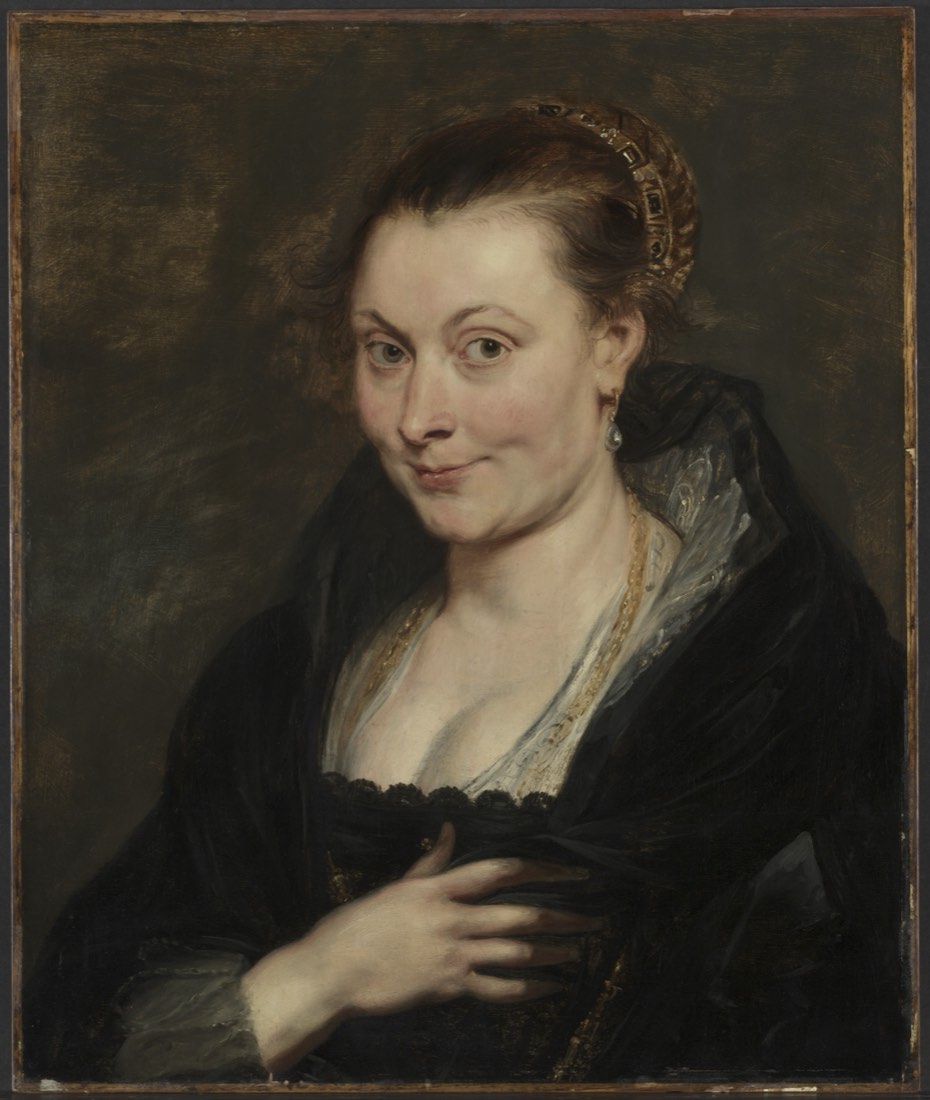
Peter Paul Rubens marries Isabella Brant on 3 October 1609 in Antwerp. The Portrait of Isabella Brant, painted around 1620-1625, shows his wife with a warm complexion and a lively expression, in broad, confident brushwork that suggests the painter's familiarity with his sitter rather than a formal commission. A technical detail confirms it: Rubens paints Isabella's face first, then adds the hands at a later date — a sign of a painting revisited and reworked over time, rather than delivered in a single sitting.
Isabella Brant dies of the plague in 1626, at thirty-four. Rubens painted several portraits of her over the course of their marriage; this one is among the last before her death.
2. Around the couple: Van Dyck, Poussin, Velázquez
In the same room, A Genoese Lady with Her Child by Anthony van Dyck, painted around 1623-1625 — that is, at almost exactly the moment his former master Rubens paints Isabella Brant — shows the same concern for elegance applied to the Genoese aristocratic clientele Van Dyck frequented during his Italian years. Velázquez's Portrait of the Jester Calabazas, painted around 1631-1632 for the Spanish court, offers a stark contrast: rather than the usual flattering elegance of court portraiture, Velázquez paints this jester holding a pinwheel and the miniature portrait of a woman — an evocation of love's inconstancy — with the same psychological gravity he reserves for his royal sitters, a way of treating a subordinate subject as a subject in his own right.
3. Poussin and Claude Lorrain, two classical landscapes
Nicolas Poussin, with several religious and mythological canvases in this same room, represents a third strand of the Baroque: colder, more constructed, more attached to classical order than either Rubens or Velázquez. His Holy Family on the Steps (1648) organises the scene around an almost architectural play of geometric balance — Mary presenting the Christ child at the centre of a composition conceived as a meditation on the Holy Family's role in redemption rather than as a religious genre scene.
Claude Lorrain, another Frenchman who spent his whole career settled in Rome, paints landscapes of an entirely different register: his Rest on the Flight into Egypt shows the Holy Family resting on a shaded bank, kneeling angels offering fruit, bathed in the golden, hazy light that made the painter's reputation and would influence generations of landscape painters after him.
4. El Greco, Spanish fervour before the Baroque
Trained in Crete, then passing through Venice and Rome before settling permanently in Toledo, El Greco paints his Christ on the Cross around 1600-1610 — a generation earlier than the other paintings in the room, but already carrying the visionary intensity that anticipates the Spanish Baroque. The figure's elongated proportions and the colours owe much to the influence of Tintoretto, while the strikingly graphic rendering of the blood answers a specifically Spanish taste for meditating on Christ's suffering. In the background can be made out the monastery of San Lorenzo de El Escorial, built by Philip II — a king who, despite this reference, never employed El Greco and kept him at a distance throughout his career.
5. Murillo, two faces of the Spanish Golden Age
Bartolomé Esteban Murillo's The Immaculate Conception, painted around 1680, shows the Virgin standing on clouds in a white robe with a blue sash, her hands crossed over her chest, gazing upward into a radiant light; five cherubs surround her with flowers and a palm frond, a crescent moon beneath her feet. The painting illustrates the doctrine that Mary was conceived free of original sin — a subject intensely venerated in seventeenth-century Spain, though not formally defined as Church dogma until 1854; Murillo painted this same theme repeatedly for Sevillian religious patrons.
In stark contrast to that celestial scene, Laban Searching for His Stolen Household Gods, painted around 1665-1670, illustrates an episode from Genesis: Jacob, having fled with his family from his uncle Laban, allows him to search his tent after Laban accuses him of theft — while Jacob's wife Rachel conceals the household idols she has secretly stolen from her father by sitting on the saddlebag holding them. The scene emphasises the eventual reconciliation between the two men after Laban comes up empty-handed; the painting belonged to a Jacob cycle on which Murillo reportedly collaborated with another painter, who handled the landscape while Murillo painted the foreground figures.
How much time
A dense room; focus on the portrait of Isabella Brant, then compare it with Velázquez's jester and the four other definitions of European Baroque that surround them.
- Portrait of Isabella Brant (Rubens) — 8 minutes.
- A Genoese Lady with Her Child (Van Dyck) — 7 minutes.
- Portrait of the Jester Calabazas (Velázquez) — 7 minutes.
- The Holy Family on the Steps (Poussin) — 7 minutes.
- Rest on the Flight into Egypt (Claude Lorrain) — 7 minutes.
- Christ on the Cross (El Greco) — 8 minutes.
- The Immaculate Conception (Murillo) — 8 minutes.
- Laban Searching for His Stolen Household Gods (Murillo) — 8 minutes.
Sources and verification
Checked against the official notices of the Cleveland Museum of Art (clevelandart.org) and cross-checked with Wikipedia EN/FR.
- Cleveland Museum of Art — Portrait of Isabella Brant, Peter Paul Rubens
- Cleveland Museum of Art — A Genoese Lady with Her Child, Anthony van Dyck
- Cleveland Museum of Art — Portrait of the Jester Calabazas, Diego Velázquez
- Cleveland Museum of Art — The Holy Family on the Steps, Nicolas Poussin
- Cleveland Museum of Art — Rest on the Flight into Egypt, Claude Lorrain
- Cleveland Museum of Art — The Immaculate Conception, Bartolomé Esteban Murillo
- Cleveland Museum of Art — Laban Searching for His Stolen Household Gods, Bartolomé Esteban Murillo
- Cleveland Museum of Art — Christ on the Cross, El Greco
- Wikipedia EN — Isabella Brant
- Cleveland Museum of Art — collection search, Room 212
Displays and room openings can change. Check the Cleveland Museum of Art website on the day of your visit before following a route.
Continue your visit
Cleveland Museum of Art
Listen to the commentary in the gallery
This route gives you a thread to follow. In front of an artwork, CulturAll adds the audio commentary: photograph the work or its label, listen, then ask your questions.

